Dalí Theatre and Museum tickets: avoiding common booking traps
Access to the Dalí Theatre-Museum in Figueres is governed by two separate constraints: the ticket channel and the entry schedule. The first affects cost. The second affects whether a ticket can be used at all.
Museum access closes 45 minutes before the official closing time, while the exhibition rooms close 15 minutes before closing. A late arrival can therefore convert a valid booking into a compressed visit.
Tickets and prices
Dalí Theatre and Museum
Figueres
01 · GetYourGuide
Entry ticket · Available today and tomorrow
€23
02 · GetYourGuide
Guided tour · 1 hour
€31
03 · Official
Official ticket · Online general admission
€18.50
Box office and online booking
Dalí Theatre and Museum — At the box office
The safest transaction is direct online booking through the official Fundació Gala-Salvador Dalí website. It avoids the museum desk surcharge and reduces exposure to third-party markups, unclear conditions, and misleading claims about skip-the-line access. The distinction is operational, not cosmetic.
The hidden cost of third-party Dalí museum tickets
Search results for Dalí Theatre and Museum tickets are dominated by intermediaries. Some sell legitimate admission. Others package admission with a guided visit, transfer, audio commentary, or a broader Figueres excursion. The problem is not the existence of these formats. The problem is that the commercial presentation often obscures what is actually being purchased.
A reseller may display a prominent headline price while placing service charges, booking fees, or mandatory add-ons later in the process. Another may advertise immediate confirmation but provide a voucher that still has to be exchanged or validated. A third may describe an entry product as skip-the-line when the real benefit is only advance reservation for a timed slot.
The ticket itself should be treated as a data record. It has attributes:
- the named venue must be the Dalí Theatre-Museum in Figueres;
- the admission date must be explicit;
- the entry time or time window must be stated;
- the product must identify whether it includes only admission or also a tour;
- the cancellation and amendment conditions must be visible before payment;
- the final price must be shown before checkout, including all mandatory charges.
When one of these fields is absent, the purchase carries avoidable uncertainty. That uncertainty has practical value to the seller. It allows a generic product to appear comparable with an official timed-entry ticket when the two are not equivalent.
The official site is the primary reference point because it defines the museum’s own admission categories and entry procedures. A reseller can reproduce those conditions, but it cannot improve them merely by adding a different interface.
A ticket is not cheaper because its headline price is lower. It is cheaper only after the final payable amount and the entry conditions are known.
How markup appears in search results
Unofficial platforms frequently sell standard admission above the price published by the museum foundation. The difference can be modest or substantial. It may reflect a guided component, but it may also be a pure intermediary markup.
The most exposed visitors are those searching under time pressure. They search for “Dalí museum Figueres entry fees,” select the first apparently available result, and interpret availability as proof of authority. It is not. A platform can have inventory without being the museum’s official ticket office.
Availability also requires interpretation. A platform may have a voucher available while the museum’s own timed-entry inventory is limited. The voucher may be valid, but its redemption process may still depend on the museum’s capacity controls. The commercial promise and the operational rule are different layers.
For a standard visit, compare the official admission product first. Only then assess whether a reseller’s additional service has a measurable benefit. A guided visit can be rational if the guide, language, duration, and meeting procedure are clearly defined. A generic “priority access” label is not sufficient evidence of a faster entry process.
Official booking versus the museum ticket desk
The official foundation provides two normal routes for general admission: booking online and purchasing at the museum ticket desk. The desk price includes a surcharge compared with the official online rate. It also exposes the visitor to queueing and to the possibility that the preferred time slot is no longer available.
The online route is therefore not simply a discount mechanism. It is a capacity-management mechanism. Timed-entry booking gives the museum a predictable flow of visitors and gives the visitor a defined arrival window. That distinction becomes more important during weekends, public holidays, and the high summer season, when unscheduled demand is less likely to be absorbed without delay.
The practical comparison is straightforward:
| Booking route | Cost structure | Capacity position | Main risk |
|---|---|---|---|
| Official online booking | Published official rate | Timed availability can be checked before travel | Preferred slots may sell out |
| Museum ticket desk | Official rate plus desk surcharge | Depends on remaining capacity | Queueing and limited same-day choice |
| Third-party reseller | May include markup or service fees | Depends on the reseller’s product and redemption terms | Ambiguous conditions or inflated cost |
| Guided admission | Higher product price because a service is added | Usually tied to a specified schedule | Paying for a format that does not match the visit |
The online ticket is not a guarantee against every problem. It does not remove the need to arrive within the stated time window. It does not convert a late arrival into a valid entry. It does not grant access to the other museums associated with Salvador Dalí.
For visitors who already know their date, official online booking is the cleanest option. For visitors with an uncertain itinerary, buying at the desk may preserve flexibility but transfers the capacity risk to the day of arrival. There is no universal best route. There is a trade-off between flexibility and certainty.
Reduced admission and age categories
Reduced admission applies to defined groups, including students aged 18 and over, juniors aged 9 to 17, Carnet Jove holders, and seniors aged 65 and above. Proof of eligibility may be required. Children from 0 to 8 years enter free of charge.
The age boundary matters. A child aged 8 falls into a different category from a junior aged 9. The junior category is not free admission. Families should select the correct ticket type rather than assuming that every minor is included without charge.
The same principle applies to student and senior categories. Eligibility is not an informal classification. It is a condition attached to the ticket. If the booking system requests supporting documentation, the visitor should be prepared to present it at entry.
What the general ticket actually covers
A standard admission ticket to the Dalí Theatre-Museum includes access to the main museum galleries and the adjacent Dalí Jewels exhibition. The jewellery collection is accessed through a separate entrance in the neighbouring building. This creates a minor but consequential navigation issue: a visitor who exits or bypasses the second entrance may believe the ticket excludes the collection, when the access point is simply separate.
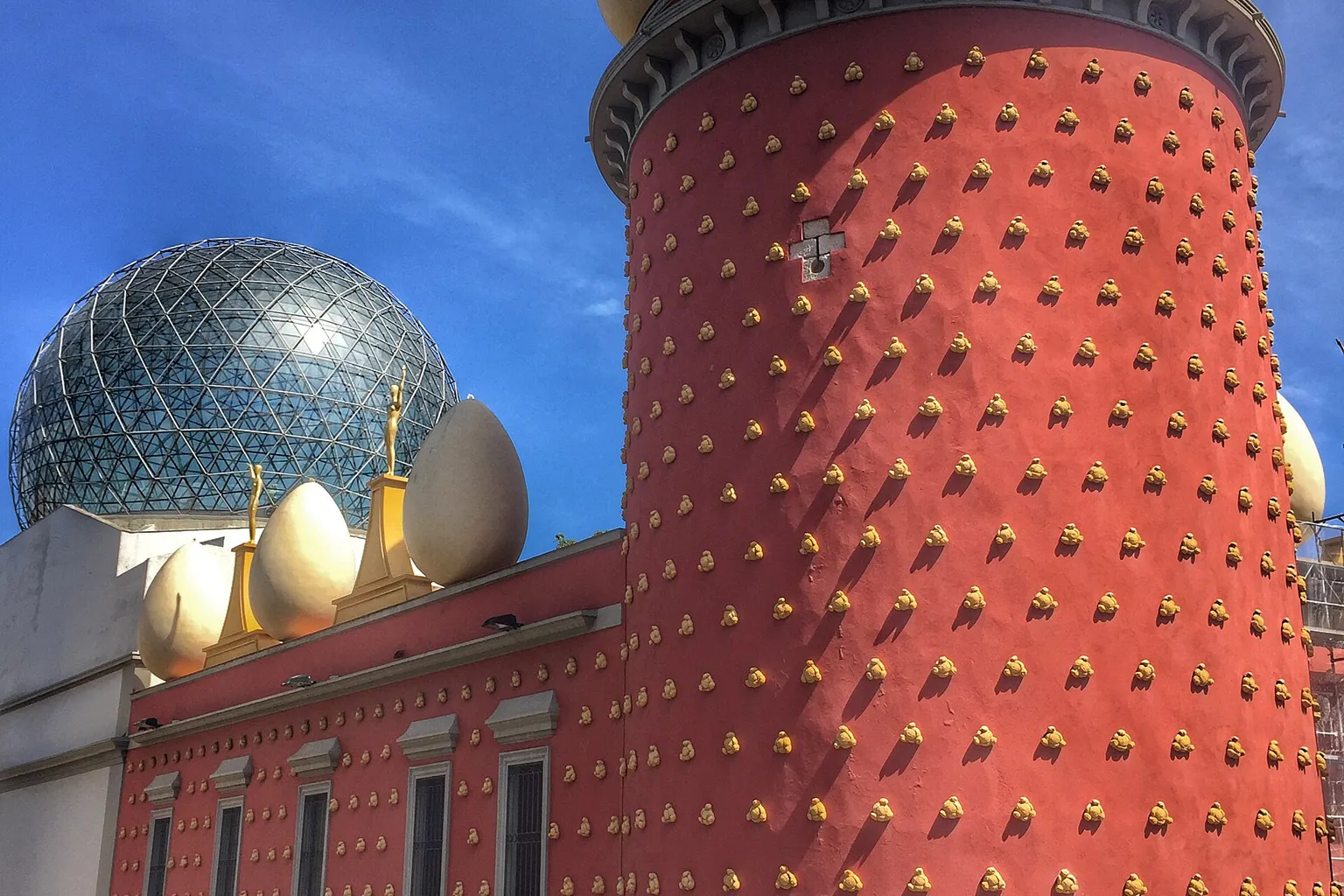
The Dalí Theatre-Museum is not a conventional chronological gallery. It was inaugurated in 1974 and conceived as a total environment associated with Dalí’s own artistic program. The building, the geodesic dome, the courtyards, the galleries, and the staged rooms form part of the object being visited. The Mae West Room is one of the best-known examples of this spatial logic: the image is resolved from a particular viewpoint rather than read as a conventional painting at close range.
This affects time allocation. A visitor who treats the museum as a sequence of wall-mounted works may underestimate the time required for rooms that depend on perspective, movement, or controlled viewing positions. The exhibition is not optimised for a rapid linear scan.
The crypt associated with Dalí is also within the museum complex. It is not a separate Dalí Triangle attraction requiring an additional ticket. Confusion arises because the foundation operates several Dalí sites under the same institutional umbrella. Institutional unity does not mean ticket unity.
The Dalinian Triangle is three admissions, not one
The Dalinian Triangle consists of three distinct locations:
1. The Dalí Theatre-Museum in Figueres.
2. The Salvador Dalí House-Museum in Portlligat, near Cadaqués.
3. Gala Dalí Castle in Púbol.
Each location requires a separate admission ticket. A ticket for Figueres does not provide entry to Portlligat or Púbol. Conversely, purchasing admission to one of the other sites does not establish access to the Theatre-Museum.
This is the most consequential misunderstanding in multi-stop itineraries. The three sites are connected by subject matter and foundation governance, not by a common admission credential. Travel planning must therefore model them as separate visits with separate capacity constraints.
The sites also differ in operational complexity. Figueres is the principal museum destination and is served by the city’s rail connections, including access via Figueres-Vilafant AVE station. Portlligat and Púbol require separate geographic planning. A visitor who books all three under the assumption of a universal ticket may discover the problem only after transport, accommodation, and timed slots have already been arranged.
A defensible itinerary records the following for each site:
- the exact venue;
- the admission date;
- the booked time, if applicable;
- the transport plan;
- the ticket’s validity conditions;
- the expected closing time;
- the contingency if arrival is delayed.
The objective is not administrative neatness. It is to prevent a capacity failure at one location from destabilising the entire route.
The Dalinian Triangle is a thematic network. It is not a single-ticket network.
Timed entry, closing procedures, and late arrival
Museum opening hours and tickets must be read together. The published closing time is not the same as the last practical entry time. Access to the museum and ticket desk ends 45 minutes before closing. Exhibition rooms close 15 minutes before the official closing time.
Those intervals have different meanings:
- the 45-minute cutoff concerns access and ticket-desk entry;
- the 15-minute cutoff concerns the closure of exhibition rooms;
- the period between those points is not equivalent to a full museum visit.
A visitor arriving shortly before the access cutoff may still enter, but the available examination time will be materially reduced. A visitor arriving after the access cutoff should not assume that an online ticket overrides the museum’s closing procedure.
The annual calendar also contains fixed exceptions. On December 24, the museum closes early at 3:00 PM. It is scheduled to close on January 1 and December 25. These dates should be treated as hard constraints when planning a Christmas or New Year itinerary.
Opening hours can vary by season and date. The correct procedure is to consult the official schedule for the intended visit date and then select a ticket slot that leaves a margin for transport. A booking that is technically compatible with a train arrival may still be operationally weak if the train is delayed or the walk from the station is underestimated.
Why “skip the line” needs qualification
The phrase “Dalí Theatre and Museum skip the line” is commercially useful because it compresses several different services into one promise. It may refer to:
- advance purchase that avoids the ticket-purchase queue;
- a reserved timed-entry slot;
- a guided group with a designated meeting procedure;
- priority handling under specific conditions;
- or simply a reseller’s marketing language.
These are not interchangeable. An online ticket can reduce exposure to the ticket desk queue, but it does not necessarily place the visitor ahead of every other timed-entry group. A guided tour may have its own assembly point and departure time. A voucher may require validation.
The relevant question is not whether the listing uses the phrase. It is whether the booking terms define the mechanism. A credible product specifies what queue is avoided, where the visitor enters, whether a time slot is fixed, and what happens if the visitor misses it.
If the answer is absent, the skip-the-line claim should be treated as a marketing category rather than a documented operational benefit.
A practical booking protocol for Figueres
The booking process can be reduced to a sequence of decisions. The sequence is more reliable than choosing by search ranking.
1. Establish the venue
Confirm that the product is for the Dalí Theatre-Museum in Figueres, not the House-Museum in Portlligat or Gala Dalí Castle in Púbol. Similar institutional branding creates a high risk of substitution.
2. Select the correct admission category
Choose general admission, reduced admission, child admission, or a guided product according to the actual visitor profile. Do not use a junior category for a child who qualifies for free entry, and do not assume that a child aged 9 to 17 is free.
3. Check the date-specific schedule
Review the official opening hours, early closures, and scheduled closure dates. December 24, January 1, and December 25 require particular attention.
4. Reserve a time compatible with transport
Allow for rail delays, station transfers, urban walking time, and the possibility of a queue at the wrong entrance. A nominally convenient slot can be fragile if the arrival plan has no buffer.
5. Read the entry instructions
Identify whether the ticket is scanned directly, exchanged at a desk, or presented at a designated entrance. Confirm the location of the Dalí Jewels entrance if the collection is a priority.
6. Retain eligibility documents
Students, juniors, Carnet Jove holders, and seniors should carry the documentation associated with the reduced category. The ticket type and the visitor’s evidence must correspond.
7. Treat third-party products as separate products
If a reseller is used, document the exact inclusion: admission only, guided visit, audio guide, transfer, or another service. Do not compare a bundled excursion with a museum-only ticket as though they were identical.
This procedure is intentionally conservative. It minimises ambiguity before payment rather than attempting to resolve it at the entrance.
Planning the visit around the museum’s internal structure
The general ticket’s inclusion of Dalí Jewels is operationally useful, but it does not mean the collection should be treated as an optional afterthought. The separate entrance can affect the order of the visit. Visitors with a fixed departure train or a narrow afternoon schedule should identify both access points before entering the main galleries.
The building itself should also be included in the time model. The geodesic dome is not merely an exterior marker. It is part of the museum’s visual identity and helps explain why the institution functions differently from a standard art-history museum. Rooms such as the Mae West installation require the visitor to move between ordinary and constructed viewpoints. The value of the visit is therefore distributed across architecture, optical effects, objects, paintings, and theatrical staging.
This is relevant to ticket selection. A short visit can still be valid, but it has a different outcome from a complete examination of the complex. Visitors arriving late in the day should not judge the museum by the number of galleries crossed. The correct measure is whether the booking provides enough time to engage with the installations that depend on perspective and spatial sequence.
The same principle applies to guided products. A guided visit may impose a fixed pace and route. That can improve orientation, but it can also reduce the time available for independent viewing. The product should be selected for its actual format, not simply because it appears higher in search results.
Where booking errors become expensive
The most common failures are predictable.
Confusing Figueres with another Dalí site.
The names are related, the foundation is the same, and the locations are not interchangeable. A ticket must identify the precise venue.
Assuming the Triangle has a shared pass.
It does not. Each of the three museums requires separate admission.
Buying from the first available reseller.
Availability does not establish official status or price efficiency. The final payable amount may be materially higher than the foundation’s rate.
Treating a voucher as direct admission.
Some products require exchange or validation. The entry instructions determine whether the voucher can be scanned at the museum entrance.
Ignoring the closing thresholds.
Entry stops 45 minutes before closing. Exhibition rooms close 15 minutes before closing. These are separate limits.
Using the wrong reduced category.
Children aged 9 to 17 are juniors and are not included in the free child category. Eligibility categories have defined boundaries.
Planning no margin around transport.
A timed ticket is an appointment with a capacity system. It is not a general promise of entry at any point during the day.
Assuming “skip the line” means universal priority.
The phrase must be unpacked into a specific queue, entrance, and procedure.
Each error is avoidable without specialist knowledge. The required discipline is to separate the variables: venue, date, time, category, product inclusions, and entry procedure.
The data-driven choice
For a standard visit to Figueres, official online booking is the lowest-ambiguity route. It exposes the museum’s own admission categories, avoids the desk surcharge, and allows the visitor to see timed-entry availability before committing to transport.
The museum desk remains a legitimate option when itinerary flexibility has greater value than advance certainty. Its disadvantages are equally clear: an added surcharge, possible queueing, and no assurance that the preferred slot remains available.
Third-party platforms occupy a narrower position. They are defensible when they provide a clearly defined additional service, such as a guided visit or transport arrangement, and when the final terms are transparent. They are weak when they merely repackage general admission with a markup or use vague priority language.
The operational conclusion is simple. Start with the official ticket inventory. Compare alternatives only after establishing the baseline. Model the Dalinian Triangle as three separate admissions. Build the visit around the 45-minute access cutoff, not the nominal closing time. Carry proof for reduced categories. Treat every “skip-the-line” claim as unverified until the mechanism is stated.
The result is not a more elaborate booking process. It is a cleaner one. The principal risk at the Dalí Theatre-Museum is rarely the absence of information. It is the failure to distinguish official rules from commercial presentation.
Practical info
Currency: EUR
Driving: on the right
Emergency number: 112
Key facts
Built: 1974
Heritage status: Cultural Asset part of the cultural heritage of Catalonia
Official website: salvador-dali.org
FAQ
Do I need a separate ticket for each Dalí museum?
What is the difference between the museum closing time and the last entry time?
Are there free tickets for children?
Does a standard ticket include the Dalí Jewels exhibition?
Why should I book through the official website instead of a third-party reseller?
Photo: JukoFF / CC BY-SA 4.0 — Wikimedia Commons