Contraceptive counseling: essential checklist for rural outreach
A rural contraceptive counseling visit can fail before the first question is asked. The pills have not reached the sub-centre. Condoms are out of stock. The only private room is occupied. The client has been sent by a relative who expects a particular answer.
The health worker has ten minutes, no referral slip, and no clear information about which services are available that day.
That is not a “communication gap.” It is a broken service pathway.
India’s NFHS-5 data recorded a total unmet need for family planning of 9.4% in 2019–21. The rural figure was higher, at 9.9%, compared with 8.4% in urban areas. At the same time, contraception was widely known and used: the National Health Mission reports awareness at 98.8%, contraceptive use among currently married women aged 15–49 at 66.7%, and modern-method use at 56.5%.
The problem, then, is not simply that people have never heard of contraception. Many clients know the names of methods. They may still lack a method that fits their reproductive goals, health needs, privacy, budget, partner situation, side-effect tolerance, or access to follow-up.
A working contraceptive counseling checklist for rural health workers must therefore do more than list products. It must keep the whole system intact: assess the client, explain real options, protect voluntary choice, supply what is within scope, and create a reliable route to facility-based care when it is not.
Addressing the rural unmet need without turning counseling into pressure
The National Health Mission defines unmet need for family planning as the situation in which currently married women want to stop childbearing or wait at least two more years before the next birth but are not using contraception.
That definition matters because unmet need is not a synonym for ignorance. It is not the same as refusal. It is not proof of contraceptive failure. It does not tell us that a woman has simply “not accepted” family planning. A client may want to delay pregnancy but face side effects, opposition at home, lack of privacy, stock-outs, transport costs, a previous bad experience, or uncertainty about where complications will be managed.
The outreach worker has to find the actual obstruction.
A useful opening assessment is short and direct:
- Does the client want to become pregnant, avoid pregnancy, or remain undecided?
- If pregnancy is not desired now, is the goal to delay the next pregnancy or stop childbearing?
- Is there a preferred timing—months, one year, several years, or permanently?
- Is the client currently using a method? If so, what is working and what is failing?
- Has the client experienced bleeding changes, pain, nausea, mood changes, difficulty with use, or another concern?
- Is the client able to make the decision privately and voluntarily?
- Is protection from sexually transmitted infections, including HIV, also required?
- Does the client need a method today, a resupply, a clinical assessment, or a referral?
Do not begin with a product. Beginning with “Which method do you want?” can sound efficient, but it often narrows the conversation too early. Beginning with “Your husband should use…” or “You have already had enough children…” is worse: it replaces counseling with social instruction.
The practical target is not maximum uptake of a particular method. The target is a method that the client understands, chooses freely, can use correctly, and can access again when needed.
High contraceptive awareness does not equal reliable contraceptive access. The failure point is often the last mile: privacy, stock, referral, follow-up, or control over the decision.
A pre-counseling checklist for ASHA workers
Before the encounter begins, the worker needs a basic operating picture. This is the point at which many outreach sessions quietly fail.
Confirm the service environment
- Identify a space where the conversation cannot be overheard by relatives, other clients, or waiting staff.
- Check which supplies are physically available, not merely listed in a register.
- Confirm the working hours of the linked sub-centre, primary health centre, community health centre, or other referral facility.
- Know which provider is authorized to deliver IUCD services, injectable contraception, or sterilization.
- Keep the referral route clear for clients who need examination, treatment, emergency care, or a method outside the worker’s authorization.
- Prepare a way to record the client’s chosen method, counseling provided, referral, and follow-up plan without exposing private details in a public register.
The phrase “available at the facility” is not enough. A method that exists in a district warehouse but is absent from the village supply point is not available to the client in front of you. A method offered only on one day each month is not equivalent to a same-day service. A referral without transport information, opening hours, or a named destination is not a functioning referral.
Essential supplies for contraceptive counseling
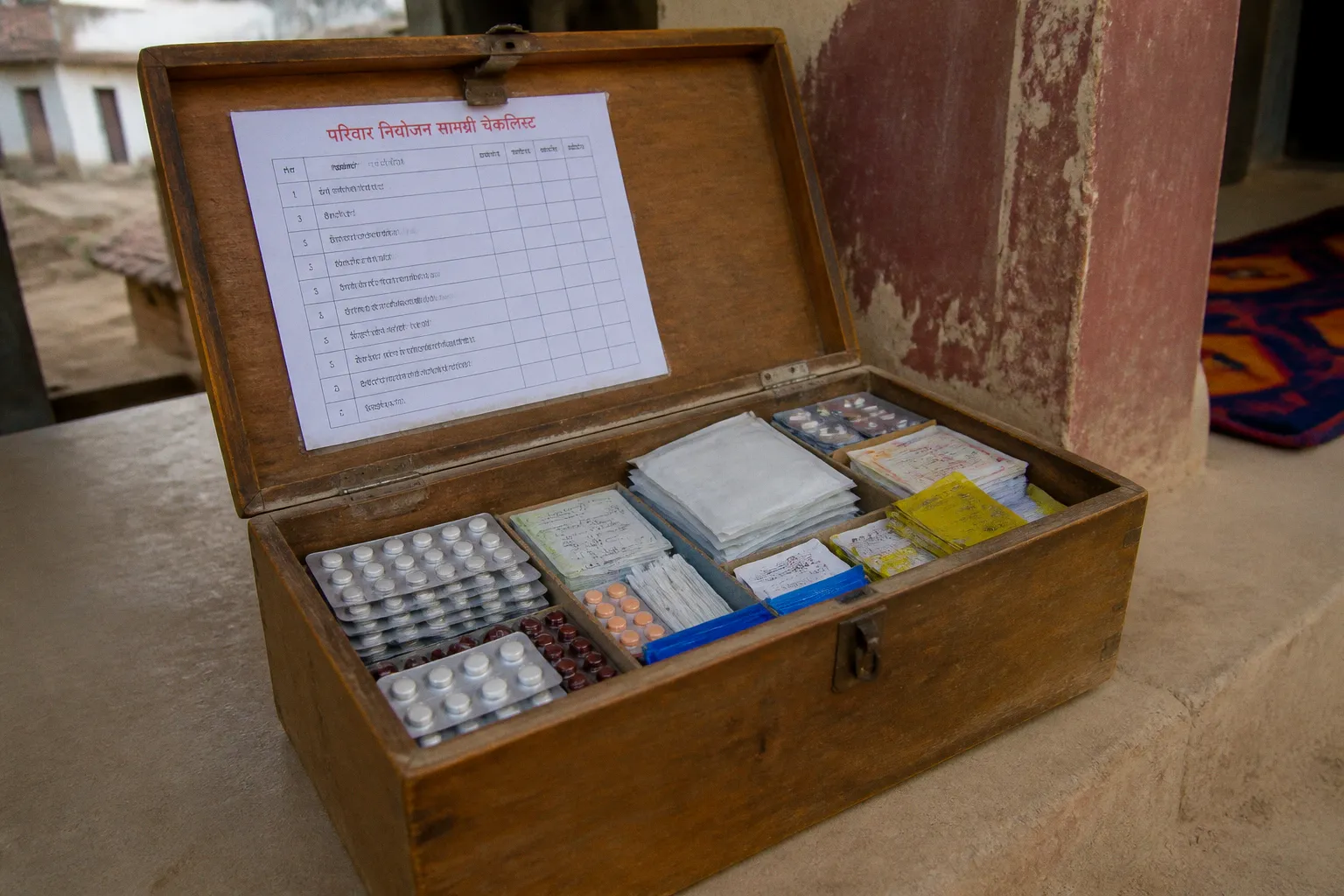
The physical kit should support both information and action:
- Oral contraceptive pills for authorized supply or resupply.
- Condoms in sufficient quantity, with clear instructions on use and storage.
- Emergency contraceptive pills where authorized.
- Simple, understandable method information in the relevant local language.
- A private counseling space or privacy screen.
- Referral slips or a reliable written referral process.
- Contact details for the linked facility or provider.
- A follow-up register that protects confidentiality.
- Basic infection-prevention materials at the facility level.
- A plan for replenishment before the next outreach session.
Stock management is not an administrative side issue. If a client makes an informed decision and then leaves without the method, the counseling has not completed the job. The gap between choice and supply becomes another reason to abandon family planning services.
The core of informed contraceptive choice
A counseling session is clinically useful only when the client can compare options in terms that affect daily life. The explanation does not need to become a lecture. It does need to be complete enough to prevent predictable failures.
For every method discussed, cover:
- How the method prevents pregnancy.
- How effective it is relative to other available options.
- How and when it must be used.
- What changes the method’s reliability, such as missed pills or incorrect condom use.
- Common side effects and which effects usually settle with time.
- Warning signs that require a return to the clinic or urgent referral.
- Whether and how quickly fertility is expected to return after discontinuation.
- Whether the method protects against sexually transmitted infections.
- What the client should do if the method is lost, missed, stopped, or poorly tolerated.
- Where the client can obtain resupply, manage side effects, or change methods.
This is the minimum operational information. “It is safe” is not a counseling explanation. Neither is “there may be some bleeding.” The client needs to know what may happen, what can be managed, and where the threshold for returning to care lies.
Match the method to the client’s operating conditions
Method choice depends on more than medical eligibility. It also depends on whether the client can realistically use the method under existing conditions.
A daily pill may work well for one client and be impractical for another who cannot store it privately or frequently forgets doses. Condoms may be the right protection for STI risk but difficult to negotiate with a partner. An injectable method may reduce daily action but require reliable return visits. An IUCD may provide long-term contraception but requires a trained facility-based provider and a route for managing warning signs. Sterilization may fit a client who has completed childbearing, but it is a permanent or limiting method and cannot be presented as reversible.
The worker should not recommend a method solely because of:
- Age or parity.
- Marital status.
- The sex of existing children.
- Caste, religion, or community background.
- A partner’s preference.
- A target for the outreach session.
- The method currently in stock.
The final choice belongs to the client, within the boundaries of safe clinical assessment and available authorization.
| Method or service | Operational point for rural counseling | What it does not cover |
|---|---|---|
| Oral contraceptive pills | Require correct, consistent use and a resupply pathway; ASHAs may provide or resupply pills under the public service framework | Do not protect against STIs |
| Condoms | Can be supplied at village level by trained ASHAs; provide pregnancy prevention and STI protection when used correctly | Depend on correct use every time and partner cooperation |
| Emergency contraceptive pills | Intended for emergency use within the authorized service pathway, with counseling on ongoing contraception | Do not replace a regular method and do not protect against STIs |
| Injectable MPA under Antara | Requires information about repeat visits, side effects, and when to return | Does not protect against STIs; availability and authorization must be confirmed locally |
| IUCD 375 or IUCD 380A | Facility-based insertion by a trained provider; the programme lists stated effectiveness periods of five and ten years respectively | Not a village-level ASHA insertion service; warning signs require a clear referral route |
| Female or male sterilization | Permanent or limiting contraception delivered through trained facility-based services or referral | Must not be described as reversible; requires voluntary, informed decision-making |
The table is a routing tool, not a substitute for clinical assessment. State-level rules, product availability, service hours, and referral arrangements can differ. A district outreach plan should verify these details before the session starts.
Screening for family planning services: triage before supply
A rural health worker does not need to perform every clinical task. The worker does need to recognize when the conversation has moved beyond routine supply or resupply.
The client screening process should establish four things: reproductive intention, current method use, immediate safety concerns, and service eligibility within the worker’s scope.
1. Clarify pregnancy and reproductive timing
Ask whether the client could already be pregnant when that affects the next step. Ask about the last menstrual period when relevant, recent unprotected sex when emergency contraception may be considered, and the client’s intention regarding a future pregnancy.
Do not make assumptions from appearance, marital status, or the number of children. If uncertainty remains, refer according to local protocol rather than improvising a clinical decision outside training.
2. Identify current problems
Ask specifically about:
- Severe or persistent abdominal or pelvic pain.
- Heavy or unusual bleeding.
- Fever or signs of infection.
- Fainting, severe weakness, or other acute symptoms.
- A suspected pregnancy with pain or bleeding.
- A possible method complication.
- Severe side effects causing the client to stop or misuse the method.
These signs are not a reason to continue a routine product conversation. They are a triage signal. Stabilize and refer through the appropriate facility pathway.
3. Establish whether the requested service is within scope
Under the public family-planning service-delivery framework, trained ASHAs can provide or resupply oral contraceptive pills, condoms, and emergency contraceptive pills at village level. IUCD services and sterilization require trained facility-based providers or referral. Injectable contraception also depends on the applicable programme and local authorization.
That boundary must be visible to the worker and understandable to the client. Do not promise same-day insertion or sterilization if the outreach team cannot deliver it. Do not imply that an ASHA can independently provide every contraceptive method.
A clean referral should state:
- The service required.
- The destination facility.
- The provider or service day, if known.
- Any preparation the client needs.
- How the client can return if the service is unavailable.
- What symptoms require urgent rather than routine care.
“Go to the hospital” is not a referral protocol. It is a handoff with the critical information removed.
Privacy, confidentiality, and non-coercive communication
A rights-based counseling encounter is not created by using polite language. It requires operational safeguards.
The adolescent-health framework in India calls for non-judgmental providers, privacy, confidentiality, community referral, and links to higher facilities. Those are not decorative standards. They are the infrastructure that allows a client to disclose sexual health concerns, ask about side effects, or reject a method without fear.
Build privacy into the workflow
- Conduct counseling away from the general waiting line.
- Ask the client whether they want a partner, relative, or other person present.
- Do not disclose a client’s method choice to family members without permission.
- Avoid discussing pills, injections, sexual activity, or sterilization in a public voice.
- Keep records in a way that does not expose sensitive information to unrelated staff or community members.
- Give the client a chance to ask questions without an accompanying person answering on their behalf.
- For adolescents, use the applicable adolescent-friendly service and safeguarding procedures rather than pushing the conversation through a parent or community intermediary.
Confidentiality has practical consequences. If a client expects that every question will travel through the village, the counseling session will produce incomplete information. The worker may then misclassify the client as “not interested,” when the actual problem is fear of disclosure.
Remove pressure from the decision
The client must be able to accept, decline, delay, discontinue, or change a method. Consent cannot be treated as a signature collected after a preselected method has already been arranged.
Watch for pressure signals:
- A partner insists on a method while the client remains silent.
- A worker frames a method as the only responsible choice.
- The client is told that refusing will harm the family or waste public resources.
- Sterilization is presented as routine because the client has a certain number of children.
- A side effect is dismissed rather than explained.
- The worker hides alternatives because they are out of stock.
The correct response is not to argue. Separate the client for private counseling where safe and appropriate, explain available options, and document the decision according to local procedure.
Consent is not a form at the end of the encounter. It is the client’s ability to understand the options, ask questions, say no, and return later without punishment.
Counseling for side effects and method continuation
Side effects are a predictable point of service failure. A client starts a method, experiences bleeding or another change, receives no usable explanation, and stops. The system records discontinuation. The client records a bad experience.
The counseling plan should therefore include a return route before the client leaves.
For each method, explain:
1. What changes are common.
2. Which symptoms can be monitored.
3. How long the client should wait before seeking routine review, if clinically appropriate.
4. Which warning signs require prompt or urgent care.
5. Which facility or provider can assess the problem.
6. Whether another method can be considered if the client wants to stop.
Never promise that side effects will not occur. Never tell a client to tolerate severe symptoms without assessment. The health worker should stay within training and authorization; method-specific clinical eligibility and complication management may require a qualified provider.
Follow-up should be scheduled around the method’s actual supply and service requirements:
- A pill user needs a dependable resupply point and instructions for missed doses according to the authorized counseling material.
- A condom user needs continued access and a demonstration or explanation of correct use when needed.
- An emergency contraceptive user needs counseling about ongoing contraception and STI protection.
- An injectable user needs a clear date or interval for the next visit.
- An IUCD user needs information about warning signs, the facility managing complications, and the process for removal or review.
- A sterilization client needs pre-procedure counseling, informed consent, facility referral, and post-procedure instructions from the authorized provider.
The follow-up plan must survive staff rotation. If the client returns and the new worker cannot tell what was discussed, the supply chain and information chain have both failed.
STI protection cannot be buried in the final sentence
Pregnancy prevention and STI prevention are related but not interchangeable tasks.
Condoms are the only contraceptive method identified in the available guidance as also protecting against sexually transmitted infections, including HIV. Pills, injectables, IUCDs, and sterilization do not provide STI protection.
Ask about STI protection without moral judgment:
- Is there a possibility of exposure to an STI?
- Does the client want dual protection?
- Is condom use consistent and acceptable to the client and partner?
- Are there symptoms requiring testing, treatment, or referral?
- Does the client need information about HIV or other STI services?
If condoms are needed, explain use clearly and ensure that supply is practical. “Use condoms” is not an adequate intervention when the client has no condoms, does not know how to use them, fears partner violence, or cannot negotiate their use safely. Where there is concern about coercion or violence, follow the relevant safeguarding and referral pathway rather than forcing a contraceptive solution onto a safety problem.
Sexual health education should also reach adolescents and unmarried clients without turning the service into a judgment gate. A client’s identity or social status is not a clinical contraindication. Privacy and appropriate referral are the control measures.
The field checklist: close the loop before the outreach team leaves
A counseling session is complete only when the client has a clear next action and the service system can deliver it.
Use this sequence during outreach:
1. Prepare the station.
Confirm privacy, supplies, referral contacts, service hours, and the provider responsible for facility-based methods.
2. Open with the client’s goal.
Ask whether the client wants pregnancy now, later, or not at all. Do not begin by pushing a product.
3. Screen for immediate concerns.
Check current method use, possible pregnancy, severe symptoms, complications, and the need for clinical assessment.
4. Explain the relevant range of methods.
Cover use, effectiveness, side effects, warning signs, fertility after discontinuation, STI protection, and access requirements.
5. Separate choice from stock.
If the preferred method is unavailable, explain the alternatives and the expected route to the preferred service. Do not substitute a method without consent.
6. Confirm understanding.
Ask the client to explain how the method will be used and where they will go for resupply or help. This is more reliable than asking, “Do you understand?”
7. Protect voluntary choice.
Confirm that the client can accept, decline, delay, or change the method without pressure.
8. Supply or refer within scope.
Provide authorized village-level methods and resupply. Refer IUCD insertion, sterilization, injectable services where required, clinical assessment, and complications to the appropriate trained provider.
9. Address STI protection.
Offer condoms and STI information when relevant, even if the client selects another pregnancy-prevention method.
10. Set the follow-up point.
Record when and where the client should return, what symptoms require earlier attention, and how the worker or facility can be reached.
11. Audit the failure points.
At the end of the session, count missed opportunities: stock-outs, unavailable providers, failed referrals, lack of privacy, incomplete counseling, and clients who wanted a method but left without one.
This final audit is where district-level improvement begins. Aggregate service numbers can show how many condoms, pills, IUCDs, or sterilizations were delivered. They do not automatically show whether clients had a real choice or whether they could continue the method. Outreach teams need to track the operational gaps that sit between contact and effective care.
What a scalable rural model looks like
A workable model does not depend on a heroic health worker compensating for every weakness in the system. It uses standard minimum steps, reliable resupply, clear authorization boundaries, and a referral network that answers the phone and receives the client.
At district and block level, the priorities are concrete:
- Maintain a method-by-method stock dashboard that reflects village availability.
- Set minimum stock levels for pills, condoms, and emergency contraceptive pills at authorized outreach points.
- Publish facility service days for IUCD insertion, injectable services, and sterilization.
- Train ASHAs and other frontline workers on counseling, privacy, warning signs, and referral—not only on product distribution.
- Give every outreach worker a current contact list for facility providers.
- Review referrals completed, not merely referrals issued.
- Monitor discontinuation caused by side effects or supply interruption.
- Include adolescents and clients seeking STI protection in service planning.
- Separate performance review from pressure to meet method-specific targets.
- Use district survey and routine programme data to locate gaps, then verify those gaps on the ground.
NFHS-5’s 2019–21 figures provide an important baseline, but they should not be presented as current 2026 estimates or as a substitute for district-specific measurement. National and rural averages identify pressure points. They do not tell a team whether the bottleneck in a particular district is stock, transport, provider availability, privacy, partner opposition, poor counseling, or treatment of complications.
That diagnosis requires local records and direct field verification.
Final position: counseling is a logistics intervention
Rural contraceptive counseling is often treated as a soft skill attached to a harder service. That is backwards. Counseling is the control system that determines whether supplies become usable care.
A client who receives a pill pack without instructions may discontinue it. A client referred for an IUCD without a service day may never reach the provider. A woman pressured into sterilization has not received rights-based care. A couple using pills without condoms may still face STI risk. An adolescent who cannot speak privately may disappear from the service pathway entirely.
The fix is not another slogan. It is a disciplined field process:
- Start with reproductive goals.
- Screen for safety and scope.
- Explain real options in plain language.
- Protect privacy and voluntary choice.
- Keep village-level supplies available.
- Route facility-based services through named providers.
- Plan for side effects, resupply, and STI protection.
- Measure where the pathway breaks.
That is how a contraceptive counseling checklist becomes more than a form. It becomes a functioning rural service.