Antara contraceptive injection safety and availability
Here is the operational truth about the Antara contraceptive injection in India: the supply is free, the molecule is well established, and the rollout is broken in ways that have little to do with pharmacology.
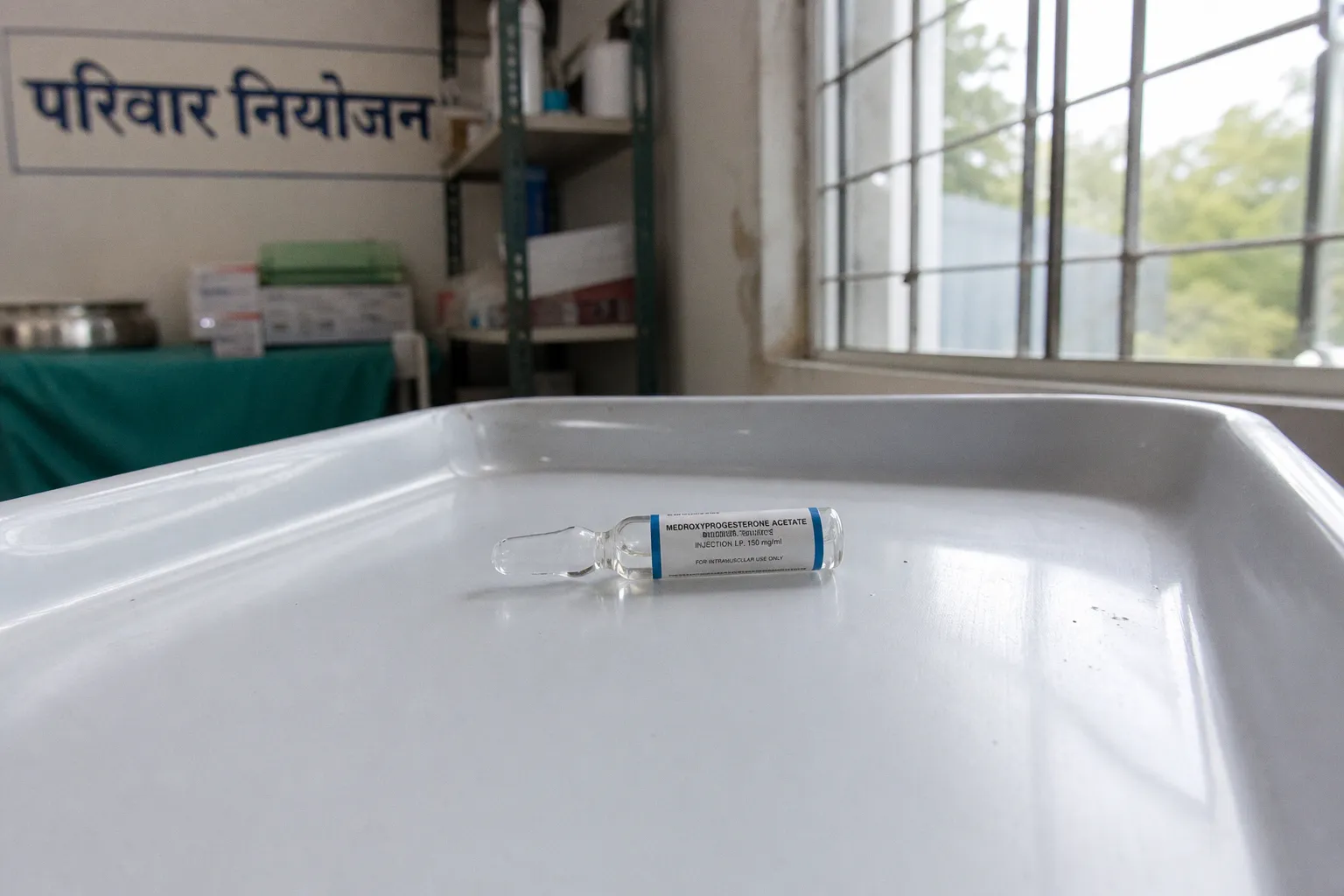
The three-monthly DMPA injection is available through government hospitals, community health centres, and other public facilities, but availability on paper does not always mean a woman can receive it when she arrives. She may find the right facility without the right provider, the right provider without stock, or the right stock without a follow-up system.
Some women receive the first dose and never return for the second. The bottleneck is not the vial alone. It is the distance to the facility, the timing of the next appointment, the absence of a reminder, and counselling that still treats menstrual changes as an unexpected complication rather than a common side effect that should be discussed before the injection.
This is the point that needs to be stated plainly: Antara works as a contraceptive, and the public system can deliver it at no cost, but the gap between those two facts is where continuation often collapses. Anyone making a decision about this method — a user, a counsellor, an ASHA worker, or a provider at a district facility — needs both the clinical reality and the operational reality. They are not the same thing.
The Antara Program: Expanding India's Contraceptive Basket
The active medicine in Antara is medroxyprogesterone acetate, commonly called DMPA. It has been used in Indian clinical practice for decades. What changed with the launch of the Antara program in 2017 was not the discovery of a new contraceptive molecule. It was the decision to make a three-monthly injectable option part of the public family-planning method mix.
The program was designed to add a reversible, female-controlled, non-daily and non-coitally linked method to a system that has historically leaned heavily on female sterilisation among couples who have completed their families. That distinction matters. A woman who wants to space pregnancies, is not ready for a permanent method, cannot use an oestrogen-containing option, or does not want a daily pill needs more than a choice between sterilisation and short-term methods.
Antara offers a different rhythm. One injection provides contraceptive protection for roughly three months, with a scheduled repeat dose rather than a daily action. The method does not depend on a partner agreeing to use a condom at every act of intercourse, and there are no pill strips that need to be stored or remembered. For some users, that privacy is not a minor convenience. It is the reason the method is feasible.
That convenience should not be confused with simplicity. An injectable method creates a different kind of responsibility: the user has to understand what may happen to her bleeding pattern, know when the next dose is due, and have a realistic way of returning to a facility. A method that is easy to take once can still be difficult to continue if the service around it is weak.
Antara is a public-sector contraceptive option with a practical advantage: it removes the daily burden. But the system still has to replace that daily reminder with reliable counselling and follow-up.
The logistics are sometimes described inaccurately. DMPA does not require routine cold-chain refrigeration in the way vaccines do. Antara can be stored without routine cold-chain refrigeration, subject to the product’s labelled storage conditions and the usual requirements for safe medicine storage. That makes distribution less demanding than the distribution of vaccines and avoids treating refrigeration as the central explanation for every stock or access problem.
The real constraints are more ordinary and more stubborn: procurement, stock visibility, trained staff, a private space for counselling, correct screening, documentation, and a functioning route for repeat doses. A facility may have the capacity to store the injection and still fail to provide the method consistently if no trained provider is available on the day a woman comes in.
Accessing Antara: Public Health Facilities and Administration Protocols
Antara is intended to be available free of charge through government health facilities. Depending on the state and district implementation, this may include medical colleges, district hospitals, sub-district hospitals, Community Health Centres, Primary Health Centres, and selected urban health facilities. The exact experience varies by location. A woman should not assume that every public facility offers the injection every day; it is sensible to ask about current availability, the trained provider, and the next repeat-dose date before making a long journey.
The private market is a different system. A private clinic may charge for the medicine, consultation, administration, or all three, and the price can vary by brand and location. The government program is therefore important not only because the injection is free, but because it can make a longer-acting reversible method available to women for whom repeated private consultations would be unaffordable.
Administration is usually organised in two stages:
| Stage | Typical provider responsibility | Practical implication |
|---|---|---|
| First dose | A trained medical provider, according to the applicable state and program protocol | Initial eligibility assessment, counselling, and review of relevant medical history take place before the method is started |
| Repeat dose | A trained nurse, ANM, CHO, or other authorised provider, according to local protocol | The woman may be able to receive later doses at a lower-level or more convenient facility |
The first-dose bottleneck is real. In many rural settings, the medical officer is already covering outpatient consultations, inpatients, emergencies, administrative work, and supervision. If that provider is away, assigned to a camp, or occupied with an urgent case, a woman who has come specifically for Antara may be asked to return another day. The protocol may be clinically defensible, but the access consequence is predictable: the method looks unavailable even when the supply is physically present.
The repeat-dose pathway is where the program is meant to become more workable. Once a woman has started the method and has received the necessary counselling and assessment, a repeat dose can often be administered by a trained provider at a lower-tier facility, depending on the local rules. This matters because the best facility for a first consultation is not necessarily the best place for every subsequent visit. A sub-centre or nearby PHC may be closer, less expensive to reach, and easier to fit around work and childcare.
The timing of the repeat dose also needs to be explained in ordinary language. The usual schedule is every 13 weeks. Program guidance allows a repeat dose to be given up to two weeks early or four weeks late, subject to the relevant clinical protocol. That window provides some resilience when a woman is travelling, ill, caring for a child, or unable to get transport on the exact date. It is not a reason to ignore the appointment. It is a buffer that helps the method survive real life.
A provider should also discuss what to do if the delay goes beyond the permitted window. Depending on the timing and the individual circumstances, the woman may need a pregnancy assessment, temporary backup contraception, or a revised injection schedule. A missed appointment is therefore not a reason to disappear from care. It is a reason to contact the facility or outreach worker promptly.
The central weakness is usually follow-up. Nobody should have to rely entirely on memory for a three-monthly method, particularly when the next date may be written on a card that is lost, damaged, or never issued. An ASHA, ANM, CHO, or facility-based reminder can make the difference between a planned continuation and an unplanned gap.
What to ask at a public facility
A woman considering Antara does not need to turn the visit into an administrative investigation, but a few practical questions can prevent avoidable confusion:
- Is Antara currently in stock, and is it being provided at this facility?
- Who administers the first dose, and does that provider need to be present on a particular day?
- Where can the repeat dose be given if the district hospital is too far away?
- What date is the next injection due, and what is the permitted early or late window?
- Whom should the woman contact if she develops troublesome bleeding or cannot return on the scheduled date?
- Will the facility or an outreach worker provide a reminder?
These questions are not bureaucratic extras. They are part of contraceptive safety because a method is safer when the user knows what to expect and can reach someone when the experience differs from expectations.
Navigating Menstrual Changes and Common Side Effects
This is where many Antara conversations go wrong. Menstrual changes are commonly described as “irregular bleeding” and then left unexplained. The woman hears the word “irregular,” notices spotting or prolonged bleeding, and concludes that something has gone seriously wrong.
DMPA commonly changes the usual menstrual pattern. Some users experience spotting or unpredictable bleeding, some have episodes of heavier or prolonged bleeding, and some gradually stop having periods. The pattern is not identical for every woman, and it may change over time. The important distinction is that these are expected side effects of the medicine, not the contraceptive mechanism itself.
The primary contraceptive action of DMPA is hormonal. It mainly suppresses ovulation, while also producing changes in cervical mucus and the lining of the uterus that contribute to contraceptive effectiveness. Menstrual irregularity occurs because the hormonal environment changes the endometrium and the usual cycle. It is a common consequence of the method, not the reason the method prevents pregnancy.
That language matters. Saying that bleeding changes are “the drug working” may be intended to reassure, but it is too imprecise. A woman can have effective contraception without having irregular bleeding, and a woman can have irregular bleeding that needs assessment even though she is using the method correctly. The accurate message is: bleeding changes are common side effects, they are often not dangerous, and persistent, severe, or concerning symptoms should be discussed with a trained provider.
The pattern often looks like this:
- Spotting or irregular bleeding: common, especially during the early months, though it can continue for some users.
- Longer or more frequent bleeding episodes: possible and often distressing if the woman was not warned in advance.
- Amenorrhea: periods may become less frequent or stop after continued use. This is not, by itself, evidence of infertility or trapped menstrual blood.
- Other reported effects: weight change, headache, dizziness, abdominal discomfort, mood changes, or breast tenderness may occur. Their frequency and severity vary between users.
A missed period while using DMPA does not automatically mean pregnancy. At the same time, amenorrhea should not be used to dismiss every concern. Pregnancy assessment may be appropriate if injections were late, if the woman had sex during a period when contraceptive protection was uncertain, or if she has symptoms that warrant evaluation.
The first conversation should include more than the sentence “your periods may change.” Good counselling gives the woman a usable map:
1. The next bleed may not follow her previous cycle.
2. Spotting does not automatically mean that the injection has failed.
3. Periods may become lighter, less frequent, or absent with continued use.
4. She can return to the facility if bleeding is prolonged, unusually heavy, painful, or accompanied by weakness, fever, fainting, or other concerning symptoms.
5. The provider can discuss treatment or another method if the bleeding pattern is unacceptable to her.
There are clinical options for managing troublesome bleeding, including reassurance, non-steroidal anti-inflammatory medicines in appropriate cases, or a short course of another hormonal method when medically suitable. These are not self-prescribing instructions. The choice depends on the woman’s health history, the pattern and severity of bleeding, pregnancy risk, and the provider’s assessment. The key point is that discontinuation should not be the only response offered.
Menstrual changes are a common side effect of DMPA, not its primary contraceptive mechanism. A woman deserves both reassurance and a route back to care if the bleeding becomes difficult to live with.
Continuation data reflects the cost of poor counselling. When women stop soon after the first dose, the reason may be the side effect itself, but it may also be the shock of encountering a side effect nobody described. An unexpected change feels like harm. The same change, explained in advance with a clear plan for management, may be tolerable.
Other safety questions also belong in the conversation. DMPA does not protect against HIV or other sexually transmitted infections, so condoms remain relevant when infection prevention is needed. Providers should review the woman’s medical history and follow current eligibility guidance rather than treating the injection as appropriate for everyone. A free method is not a reason to skip screening, and a common side effect is not a reason to frighten women away from a useful option.
Postpartum Use and Breastfeeding Safety Guidelines
Postpartum contraception is one of the situations in which timing and counselling have to be precise. A woman may want reliable spacing soon after delivery, while also breastfeeding and recovering from childbirth. She needs a method that fits her health status, feeding plans, fertility intentions, and ability to return for follow-up.
Antara can be used by breastfeeding women when it is started at the appropriate time under the applicable clinical guidance. In the Indian public-health context, initiation at or after six weeks postpartum is commonly used for breastfeeding women. The practical rule should not be reduced to a slogan: the provider needs to confirm the woman’s postpartum timing and assess whether DMPA is suitable for her.
The medicine is not generally considered to reduce breast-milk quantity or quality in a clinically meaningful way. That reassurance is important because fear of losing milk can make a breastfeeding woman reject contraception altogether. But “safe during breastfeeding” does not mean “give it at any time without assessment.” The timing of initiation, the woman’s medical history, and the current national or facility protocol still matter.
At the counselling desk, the distinction is straightforward:
- A woman who is six weeks or more postpartum and breastfeeding may be considered for Antara after appropriate assessment.
- A woman who is only a short time past delivery needs a different discussion about timing and interim contraception.
- A woman with postpartum complications or symptoms should be assessed for those problems rather than being moved through a routine contraceptive line.
- A woman who is unsure whether she wants another pregnancy soon should hear the fertility-return timeline before choosing a method whose effect can persist beyond the last scheduled dose.
The postpartum use case also exposes the first-dose access problem. Women often return to public facilities for infant immunisation, growth monitoring, or their own postpartum review. These visits are a natural opportunity to discuss contraception, but the provider offering the infant service may not be authorised to administer the first Antara dose. If no clear referral route exists, the opportunity is lost. The woman leaves with information but no method, or with a request to make a separate trip to a district facility.
A better workflow would connect the six-week maternal review, infant-care visits, and family-planning counselling without assuming that the woman can make several separate journeys. The ASHA or ANM can identify interest, explain the basic timing, and help arrange the medical assessment or referral required by local protocol. The system does not need to pretend that every provider can perform every task. It does need to ensure that the handoff is real.
Understanding Fertility Return and Long-Term Considerations
The two questions women ask most often about any injectable contraceptive are simple: will I be able to become pregnant afterwards, and how long will it take?
For Antara, fertility does return, but the return of ovulation can be delayed compared with some other reversible methods. The delay is not permanent infertility. DMPA remains active in the body after the date on which the next injection would ordinarily be due, and ovulation may take additional time to resume after the final dose.
An average return to fertility of around ten months after the last injection is often cited in counselling. That is an average, not a promise or a deadline. Some women may ovulate sooner, while others may take longer. The relevant interval is counted from the last injection, not simply from the day a woman decides not to continue.
This timeline has practical consequences. A woman who wants to conceive within a very short and predictable interval may prefer to discuss other reversible options. A woman who is comfortable with a possible delay and values the privacy and convenience of a three-monthly injection may find Antara a good fit. Neither preference is more rational than the other. The method has to match the woman’s reproductive plan, not just the provider’s inventory.
The fertility delay should be stated directly, without turning it into a warning designed to scare users. “Your fertility will return” is incomplete if it leaves out the possibility that ovulation may take months to resume. Conversely, “it can make you infertile” is wrong and can reinforce an existing myth. Accurate counselling sits between those two statements.
Stopping the injection also does not require a “detox,” a cleansing treatment, or a special procedure to remove the drug. If pregnancy is desired, the woman can discuss preconception care, folic acid, chronic medical conditions, and the timing of pregnancy planning with a qualified provider. If pregnancy does not occur immediately, that does not automatically mean the method caused permanent damage.
Long-term use should be reviewed as an ongoing clinical choice rather than treated as a one-time decision. At each repeat visit, the provider can ask whether the woman is satisfied, whether the bleeding pattern is manageable, whether she has developed new medical concerns, and whether her pregnancy intentions have changed. A method that suited a woman after her first child may not be the method she wants two years later.
Bone health is another topic that may arise during longer-term counselling. The decision to continue DMPA should consider the individual woman’s circumstances and current guidance. It should not be turned into a blanket claim that every user will suffer permanent bone damage, nor should concerns be dismissed without a conversation. Providers can review risk factors, diet, physical activity, other medicines, and alternative methods where appropriate.
The same principle applies to weight change and mood symptoms. Some women notice changes; others do not. A provider should take a reported problem seriously, assess possible causes, and discuss options rather than insisting that the symptom cannot be related or that the woman must simply tolerate it. Respectful continuation is not the same as forcing continuation.
What the System Still Has to Fix
Antara is not a product problem. It is a delivery problem with identifiable points of failure.
The first is the gap between the initial consultation and the second dose. The second is the gap between a side effect and a provider who can explain or manage it. The third is the gap between a woman’s interest at a routine maternal or child-health visit and an actual first dose. Each gap is operational, but each one has a direct effect on safety and continuation.
Several changes would make the program more credible at district level:
1. Standardise first-dose counselling without turning it into a script. Every woman should hear, in a language she understands, that bleeding may become irregular, that periods may become lighter or stop, that the injection does not protect against sexually transmitted infections, and that a repeat dose is due at a specific time. The conversation should include what to do if bleeding is difficult, not just the phrase “side effects may occur.”
2. Give every user a practical follow-up route. A date on a card is useful, but it is not a follow-up system. The woman should know which facility can provide the repeat dose, which worker can remind her, and whom to contact if she is late. ASHA and ANM outreach, phone reminders, and facility registers can complement one another.
3. Make the early and late window understandable. A four-week late window is clinically useful only if the woman knows it exists and knows what to do when she misses the preferred date. Staff should explain the buffer without encouraging indefinite delay.
4. Reduce unnecessary first-dose barriers. The initial eligibility assessment still needs to follow clinical and program rules, but the service should not depend on a single doctor being physically available without a referral or backup arrangement. Districts should map which providers can assess and administer the first dose and where women are sent when the usual provider is absent.
5. Integrate postpartum counselling into existing visits. The six-week maternal review, infant immunisation contact, and routine outreach visits should connect women to contraceptive services. The aim is not to pressure a woman into an injection. It is to ensure that Antara is mentioned as one option and that an interested woman is not sent away without a workable next step.
6. Track continuation locally. A district average can conceal a facility where women receive the first dose but almost never return. Facilities need feedback on repeat-dose uptake, missed appointments, reported bleeding concerns, stock interruptions, and referral delays. The point is not to punish providers or users. It is to identify where the system is losing people.
7. Treat side-effect management as part of the service. If a woman returns with bleeding concerns, the answer should not be an automatic dismissal or an automatic discontinuation. She needs assessment, reassurance where appropriate, treatment options when indicated, and the freedom to choose another method if Antara no longer suits her.
The public-health value of Antara lies in the combination of characteristics: it is reversible, non-daily, private, and available free through government services. Those advantages are meaningful only when the supply is dependable and the woman can receive the next dose without repeating an exhausting journey. A method that exists only in a district inventory is not the same as a method that exists in a woman’s life.
The practical verdict on Antara contraceptive injection side effects and availability is therefore balanced. The injection is not a permanent method, menstrual changes are common but are not the contraceptive mechanism, breastfeeding use requires correct postpartum timing and clinical assessment, and fertility can take time to return after the last dose. On the access side, public provision can remove the price barrier, but not automatically the distance, staffing, stock, or follow-up barriers.
The drug is established. The schedule is relatively forgiving. The method is reversible. What remains is the operational layer — the part that determines whether a woman who walks in for Dose 1 can understand the experience, manage the side effects, find the next facility, and return for Dose 2 if she chooses to continue.
That work is unglamorous and logistical. It is also where Antara’s success will be decided.