Free IUCD insertion: avoiding out-of-pocket clinic costs
A copper IUCD can be inserted free of charge at public health facilities in India, including Primary Health Centres and district hospitals. Yet the patient’s actual financial exposure is not necessarily zero.
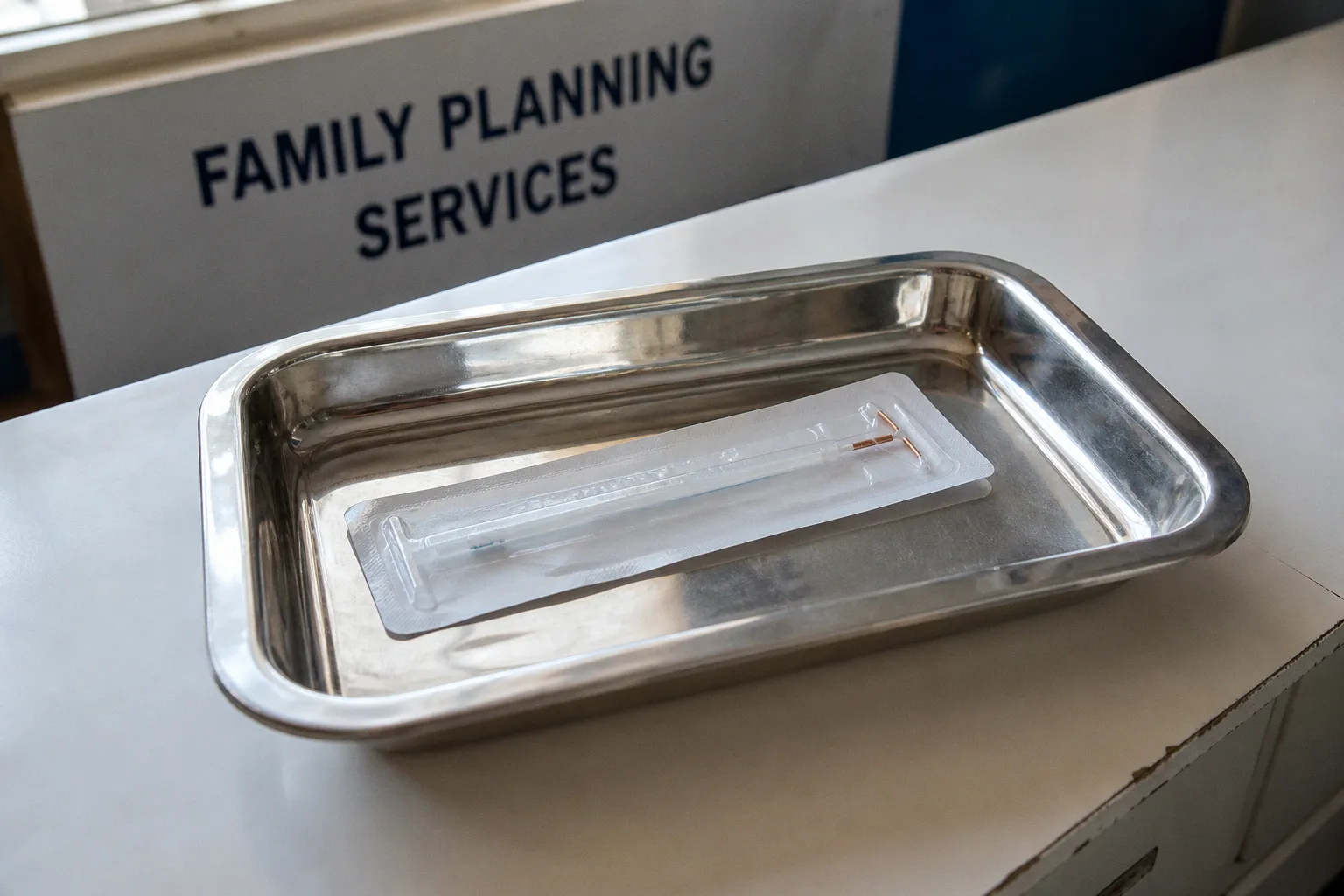
Free IUCD Insertion in India: Avoiding Out-of-Pocket Clinic Costs
Travel, diagnostic tests, medicines, informal payments, and referrals can convert a formally free service into a partially paid episode of care.
The distinction is operational, not semantic. Under the National Health Mission, IUCD insertion is a government-provided service. In private facilities, the same intervention may cost from INR 300 to INR 2,500 for a copper device and from INR 8,000 to INR 17,000 for a hormonal intrauterine system. The price gap is large. Access gaps remain larger.
The public health mandate: what “free IUCD insertion” covers
India’s public family planning programme provides IUCD insertion through government facilities. This includes the standard copper IUCD, commonly referred to as Copper T, and postpartum or post-abortion insertion where trained services are available.
The relevant public facilities include:
- Primary Health Centres and equivalent first-contact facilities.
- Community and higher-level public health institutions.
- District hospitals.
- Public maternity and post-abortion care units where the service is integrated into clinical workflows.
The policy position is straightforward: the insertion service is provided without a user fee at public facilities. The device supplied through the public programme is also part of the service package. A patient should not be required to purchase a standard government-supplied copper IUCD from a private pharmacy as a condition of receiving insertion at a public facility.
That does not mean every possible cost surrounding the visit disappears. A facility may not have the required device on a particular day. A patient may be referred to another institution. Transport may be paid privately. A clinician may prescribe treatment for a condition identified during examination. These are separate cost components and should not be conflated with an official IUCD insertion charge.
The practical question is therefore not simply, “Is IUCD insertion free?” It is:
Is the entire care pathway free, or only the procedural line item?
That distinction determines the household burden.
A facility can comply with the public policy while a patient still spends money to reach the facility, obtain medicines, complete tests, or return for management of side effects. National data systems often record service uptake more reliably than these smaller expenditures. As a result, formal coverage can look strong while effective financial access remains uneven.
What is normally included
For a standard copper IUCD insertion in a public facility, the patient generally enters a service pathway that includes counselling, eligibility assessment, the device, insertion, and instructions for follow-up. The exact workflow varies by state, facility level, staffing pattern, and clinical timing.
The cost-free status applies most clearly to the government service itself. It should not be interpreted as a guarantee that every associated clinical requirement is available at every facility without delay or incidental expense.
The principal sources of variation are:
- Whether the facility has a trained provider available.
- Whether the required IUCD type is in stock.
- Whether insertion is requested immediately after childbirth, after abortion, or during an interval visit.
- Whether the patient has symptoms that require additional assessment.
- Whether follow-up care is available at the same facility.
- Whether the patient is directed to a higher-level institution.
A public facility may therefore be the lowest-cost route without being the shortest route. A private clinic may offer faster scheduling and more predictable stock, but at a substantially higher direct price.
Postpartum and post-abortion insertion: the incentive structure
India’s programme has a specific financial incentive mechanism for postpartum IUCD and post-abortion IUCD services. Under the Performance Linked Payment Plan, the beneficiary receives INR 300. The service provider receives INR 150, and the facilitating ASHA worker receives INR 150.
The combined structure distributes INR 600 across the service episode:
| Recipient | Incentive |
|---|---|
| Beneficiary | INR 300 |
| Service provider | INR 150 |
| Facilitating ASHA worker | INR 150 |
This is not a patient fee. It is a programme incentive intended to support acceptance, service delivery, and community-level facilitation. The beneficiary payment is designed to offset some of the economic friction associated with accepting the method, particularly around the immediate postpartum or post-abortion period.
The value is material but limited. INR 300 may offset local transport or part of the opportunity cost of attending a facility. It does not eliminate all household expenditure. Nor does it compensate for repeated visits, private purchases, or travel across a district when the nearest facility lacks a trained provider.
The timing of insertion also changes the cost structure of service delivery. Economic analyses from Madhya Pradesh and Uttarakhand estimated the public-system unit cost of a postpartum IUCD insertion at INR 522 and INR 502, respectively. The corresponding cost for interval IUCD insertion was lower: INR 281 in Madhya Pradesh and INR 287 in Uttarakhand.
These are system costs, not amounts billed to the patient. They include the resources required to provide the service: staff time, commodities, facility use, logistics, and associated delivery inputs. The higher postpartum cost reflects the more complex clinical setting and the need to integrate insertion with childbirth care.
The difference between system cost and user charge is central to interpreting public health data. A free service is not costless to deliver. The government absorbs the expense through programme financing. The patient is shielded from the official fee, but not necessarily from every transaction required to reach and use the service.
The private-sector price gap
Private-sector prices create the clearest financial contrast. A copper IUD insertion typically costs between INR 300 and INR 2,500, depending on the clinic, location, device, consultation structure, and whether the quoted amount includes the device and procedure.
Hormonal IUCDs, including levonorgestrel-releasing systems such as Mirena, occupy a different price category. Reported private prices range from INR 8,000 to INR 17,000. This amount reflects the higher acquisition cost of the device, not merely a higher procedural fee.
The comparison is not between two identical products sold through different channels. The standard public programme has historically relied on copper IUCDs, including CuT380A, introduced into India’s family planning programme in 2002. Hormonal systems have different clinical characteristics, different procurement economics, and substantially higher market prices.
| Parameter | Public-sector copper IUCD | Private copper IUD | Private hormonal IUD |
|---|---|---|---|
| Typical direct price for device and insertion | No official user fee | INR 300–2,500 | INR 8,000–17,000 |
| Main cost payer | Government programme | Patient | Patient |
| Product category | Standard copper IUCD | Copper IUD, brand and clinic dependent | LNG-IUS or equivalent hormonal system |
| Availability | Dependent on public stock and trained staff | Usually linked to clinic inventory | Dependent on clinic inventory and prescribing practice |
| Financial predictability | Low if ancillary costs or referrals arise | Variable but quoted in advance more often | High direct cost, with possible consultation and follow-up additions |
| Likely reason for use | Programme access and affordability | Convenience, availability, or preference | Method preference and clinical suitability |
A public facility’s package cost has been estimated at INR 1,259 for a Copper IUD, with a 95% confidence interval of INR 1,051–1,470. For a levonorgestrel intrauterine system, the estimated package cost was INR 3,474, with a 95% confidence interval of INR 3,270–3,678.
Again, these are economic costs to the health system, not retail prices. They show why the state can provide a copper IUCD without charging the user while still incurring a measurable service cost. They also show why a hormonal system cannot be treated as a simple substitute for the standard public copper device.
The Central Government Health Scheme reimbursement schedule provides another reference point. For IUD, IUCD, or pessary insertion under code OG082, the rate effective from October 13, 2025, is ₹4,000 in Tier X metropolitan NABH-accredited hospitals, ₹3,600 in Tier Y cities, and ₹3,200 in Tier Z cities. These are reimbursement rates in a defined scheme. They should not be read as a national private-sector tariff or as the amount every patient will pay.
Why households still pay when the service is free
The persistence of out-of-pocket costs is not evidence that the public policy has no effect. It indicates that financial protection is incomplete when measured across the full pathway.
A useful decomposition separates five stages:
1. Access cost. Transport, lost wages, childcare, and food expenses can arise before the patient enters the facility.
2. Clinical assessment cost. Additional examinations, laboratory tests, or medicines may be recommended when symptoms or pregnancy status require evaluation.
3. Commodity cost. Stock-outs can lead patients to purchase a device or related consumables privately, although this should not be the default requirement for a standard public IUCD service.
4. Referral cost. A patient may travel to a community health centre, district hospital, or another institution if the first facility lacks trained staff or supplies.
5. Follow-up cost. Management of pain, bleeding, suspected infection, expulsion, or method removal may require further visits and treatment.
These costs are not uniformly distributed. They are higher for rural households living far from a facility, for women with limited control over household transport, and for patients who cannot absorb a day away from paid or unpaid work.
The available evidence does not establish a national percentage of women who incur informal payments specifically for IUCD insertion at public facilities. That number should not be invented from anecdotal reports or from general public-sector expenditure studies. The more defensible conclusion is narrower: formal free provision does not guarantee zero expenditure in every patient episode.
The public price is zero. The economic cost of reaching the service is not.
The distinction also applies to counselling. A method may be available at no charge but remain functionally inaccessible if the patient receives incomplete information about expected bleeding changes, warning signs, removal, or alternative methods. A poorly explained service increases the probability of discontinuation and repeat visits. Those repeat contacts have costs even when the insertion itself was free.
The low-utilization paradox
IUCD access demonstrates a standard public health paradox: a service can be officially available, clinically effective, and financially subsidized while remaining a minor component of contraceptive use.
Historically, IUCDs have represented below 2% of India’s total Couple Protection Rate. The explanation is not a single variable. It is a combination of method perception, provider capacity, timing, and service reliability.
The principal barriers include:
- Fear of pain, bleeding, infertility, or other side effects.
- Inadequate counselling before insertion.
- Limited provider training and low procedural confidence.
- Restricted availability outside selected facilities.
- Concern about removal access if the method is not tolerated.
- Informal expenses or uncertainty about what the facility will provide.
- Preference for short-term methods that can be started without a pelvic procedure.
- Gendered decision-making within households.
- Weak adolescent access to confidential sexual and reproductive health information.
A low contraceptive prevalence rate for IUCDs should therefore not be interpreted as simple consumer rejection. Utilization is produced by the interaction between demand and supply. If a woman reaches a facility and finds that the trained provider is absent, the device is unavailable, or the service is offered only at a distant hospital, the recorded “choice” not to use an IUCD is partly a system outcome.
Provider training is particularly important. IUCD insertion is a technical procedure, but the relevant competency includes more than device placement. It includes screening, infection prevention, correct timing, management of difficult insertions, counselling, recognition of warning signs, and removal. A programme that expands inventory without expanding these competencies can produce nominal availability without reliable access.
The same applies to postpartum services. Delivery facilities are logical locations for immediate postpartum insertion, but the intervention must be integrated into maternity workflows. Counselling should occur before labour whenever possible. Consent should be documented. The woman should receive clear information about the expected course and the route for removal or complication management.
A financial incentive may increase acceptance or provider participation. It cannot substitute for service quality. Payment mechanisms address one constraint. They do not correct stock management, staffing gaps, or poor counselling.
Reading public-sector costs without confusing them with clinic charges
Economic studies often report a package cost, unit cost, or reimbursement rate. These measures answer different questions.
A package cost estimates the resources required to provide a defined service. The estimated ₹1,259 cost for a public Copper IUD package, for example, is a health-system accounting measure. Its confidence interval—₹1,051 to ₹1,470—shows the uncertainty around that estimate.
A unit cost refers to the cost per insertion under a particular delivery model and location. The estimates of INR 522 for postpartum insertion in Madhya Pradesh and INR 502 in Uttarakhand describe the cost to the public system, not the beneficiary.
A reimbursement rate is the amount a defined payer recognizes under a specific schedule. The CGHS rates of ₹4,000, ₹3,600, and ₹3,200 vary by city classification and hospital accreditation. They are not evidence that all Indian private clinics should charge those amounts.
A retail or out-of-pocket price is what the patient is asked to pay. It may include the device, provider fee, consultation, consumables, ultrasound, laboratory work, medication, and follow-up. The invoice structure matters. A quoted “IUCD cost” without a breakdown is not sufficient for comparison.
These categories can diverge substantially:
| Measure | What it represents | Who typically pays |
|---|---|---|
| Public package cost | Total estimated resources used to deliver the service | Government or public health system |
| Public unit cost | Cost per insertion under a specified service model | Government or public health system |
| Scheme reimbursement | Amount reimbursed under defined rules | Scheme payer |
| Private quoted price | Amount requested by a clinic for a selected service package | Patient or insurer |
| Household out-of-pocket cost | Direct and indirect expenditure incurred by the household | Patient and household |
The distinction prevents two common analytical errors. First, a public service costing ₹1,259 does not mean the patient should be charged ₹1,259. Second, a private quote of INR 8,000–17,000 for a hormonal system does not indicate that all IUCD insertion is expensive. It indicates that product type and delivery channel materially change the price.
How to reduce avoidable expenditure
The lowest-cost route is usually to begin with the public system rather than to purchase a device privately and seek insertion elsewhere. The first point of contact may be a government primary facility, community-level health worker, public maternity unit, or district hospital. Availability is local, so the route should be confirmed before travel.
A patient seeking a free public IUCD service should establish four facts in advance:
- Whether the facility currently offers IUCD insertion.
- Whether it provides interval, postpartum, or post-abortion insertion.
- Whether a trained provider is scheduled on the intended day.
- Whether the standard copper IUCD is in stock.
These questions reduce the risk of an unproductive visit. They also separate an official public-service limitation from a private-sector sales pitch.
At the facility, the patient can ask for an itemized explanation of any requested payment. If a staff member asks for money, the relevant question is whether the amount is an official fee, a prescribed medicine cost, a diagnostic charge, or an informal payment. The categories should not be merged. A patient should not be required to pay a “service charge” for a standard public IUCD insertion merely because the procedure is being performed at a public institution.
Where a device is unavailable, purchasing a private device is not automatically the best response. The patient may instead ask when stock will return or whether another public facility in the district can provide the service. The rational choice depends on the value of time, transport cost, clinical urgency, and the patient’s preference for a specific device.
For private care, the quote should distinguish at least:
- Device name and type.
- Insertion fee.
- Consultation fee.
- Any required tests.
- Medicines and consumables.
- Follow-up consultation.
- Removal charges.
- Management of complications or expulsion.
This is particularly important for hormonal IUCDs. The price range of INR 8,000 to INR 17,000 is broad. The variation may reflect the device, clinic location, provider, supply chain, and included follow-up. A low initial quote may exclude the consultation or device cost. A high quote may include several visits. Without an itemized estimate, the figures are not comparable.
Household expenditure extends beyond IUCDs
IUCD costs sit within a wider family planning market. Private out-of-pocket expenditure on family planning commodities in India was estimated at $142.7 million in 2019. Oral contraceptive pills accounted for 58% of this spending, and condoms accounted for 29%.
These figures are not an estimate of IUCD insertion costs. They show that the private market remains a major route for contraceptive access, particularly for methods that are easy to obtain without a facility procedure. The distribution of spending also reflects method mix and purchasing behaviour. A product with a low unit price can generate substantial aggregate expenditure when used repeatedly across millions of households.
This matters for reproductive welfare policy. Free access to a long-acting method does not automatically reduce household expenditure if the service is difficult to reach or if users distrust it. Conversely, a short-term method can appear more accessible while creating recurring costs over time.
The correct comparison is therefore not only the price of insertion. It is the cost of sustained method use, including discontinuation, switching, follow-up, and treatment of side effects. Those calculations require longitudinal data. Cross-sectional clinic prices cannot provide them.
The policy implication: free provision must be measured as effective access
The public programme has already removed the largest formal price barrier for standard copper IUCD insertion. The remaining problem is implementation.
A more complete district-level assessment would track:
- Stock-out days for copper IUCDs.
- Number and distribution of trained providers.
- Waiting time from request to insertion.
- Share of facilities offering interval, postpartum, and post-abortion services.
- Referral rates between facility levels.
- Removal availability.
- Reported informal payments.
- Travel time and transport expenditure.
- Method continuation and complication-management visits.
- Uptake by residence, age, parity, socioeconomic status, and district.
These variables would distinguish nominal service availability from functional access. A district with 100% policy coverage but frequent stock-outs is not equivalent to a district where insertion is available every day with trained staff and follow-up capacity.
The same dashboard should report uncertainty. Estimates of costs should include confidence intervals. Utilization rates should be disaggregated by stratified cohorts rather than presented as a single state average. A national mean can conceal a substantial district-level variance.
The financial architecture is also measurable. The INR 300 beneficiary incentive for postpartum and post-abortion IUCD acceptance may reduce direct economic resistance, but its effect should be evaluated against counselling quality, provider participation, continuation, and removal access. An incentive that increases initial acceptance but does not improve continuation may shift the timing of expenditure rather than reduce it.
The immediate conclusion is narrow and supported by the available evidence. Public facilities in India provide IUCD insertion without an official user fee. Private-sector prices are materially higher, especially for hormonal systems. Household expenditure can persist through transport, referrals, tests, medicines, stock-outs, and informal payments. The national average of these indirect costs is not established with sufficient precision to state otherwise.
Free IUCD insertion is therefore a policy entitlement, not a guarantee of a zero-cost reproductive health experience. The next measure of programme performance should be the proportion of women who can obtain, continue, and remove the method without avoidable financial or geographic friction. That is the difference between a service listed as available and a service that functions.