Measles vaccine timing for infants in India
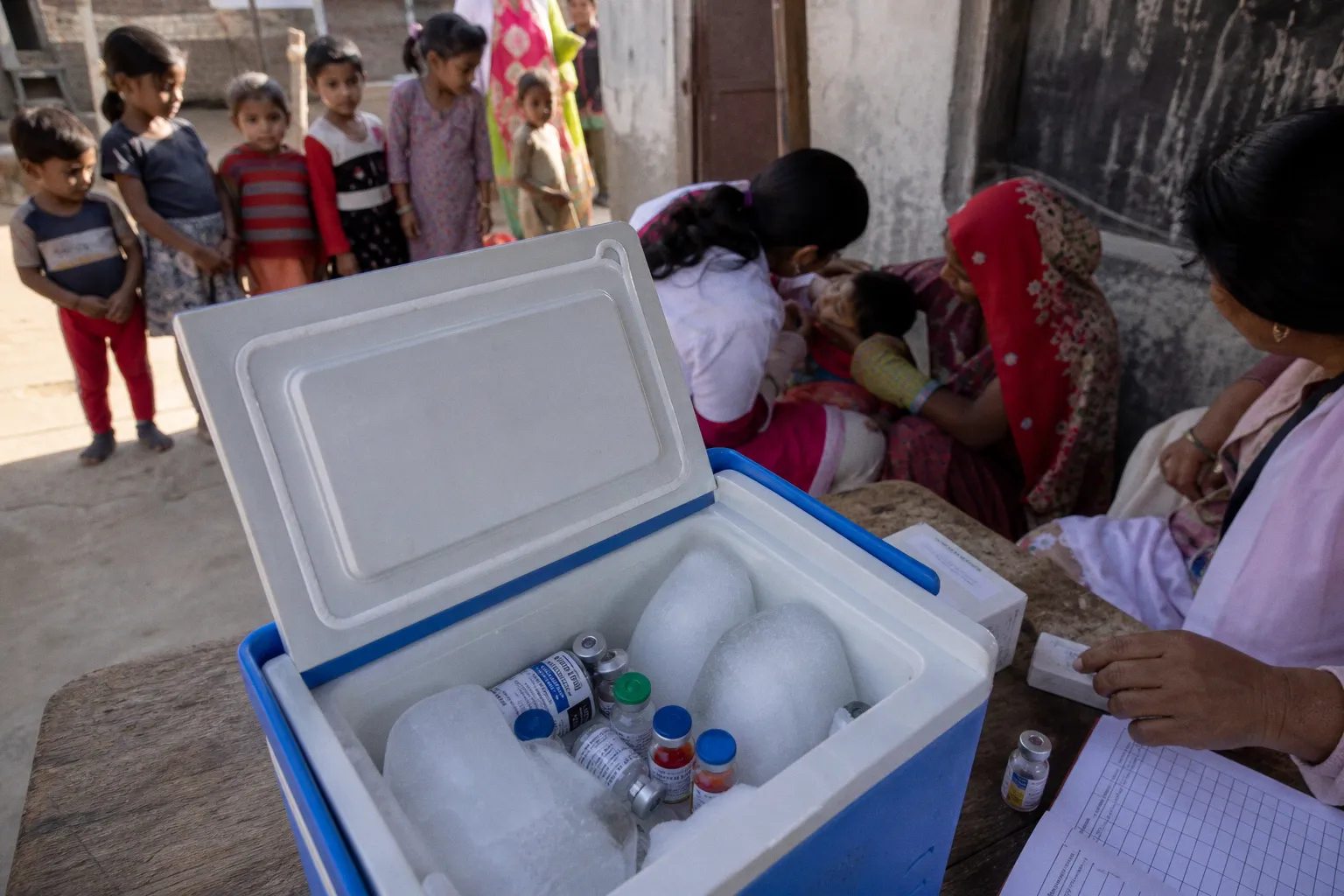
In India's public immunization system, a nine-month-old infant receiving the first measles-rubella dose at a sub-centre has technically completed the system's primary obligation at that moment.
Measles Vaccine Schedule in India: UIP vs IAP Guidelines
The cold chain has held, the ANM (Auxiliary Nurse Midwife) has administered the dose, the register is updated. What happens next, however, exposes a fault line that runs through the entire programme: the second dose. Under the Universal Immunization Programme (UIP), it is expected between 16 and 24 months. Under the Indian Academy of Pediatrics' private-sector schedule, it is expected at 15 months, with a third dose at four to six years. Two systems, two schedules, one child, and a coverage gap that quietly decides whether measles survives or is eliminated before India's 2026 target.
The dropout between dose one and dose two is where the system leaks. Closing that gap is the entire game.
The UIP's Two-Dose MR Architecture
The Universal Immunization Programme is the spine of India's public-sector immunization. Within it, the Measles-Rubella (MR) vaccine is delivered in two doses, free of cost, through sub-centres, Primary Health Centres (PHCs), Community Health Centres (CHCs), and anganwadi outreach. The architecture is deliberate:
- First dose: 9 to 12 months of age, administered subcutaneously in the right upper arm, standard 0.5 ml volume.
- Second dose: 16 to 24 months, same route, same volume.
That is the entire routine MR schedule in the public system. No third dose. No mumps component. The vaccine protects against measles and rubella only — both on India's national elimination agenda — but not mumps, which is not.
The strategic logic is herd-immunity threshold math. One dose of a measles-containing vaccine (MCV) delivers roughly 85% individual protection; two doses push that past 95%. For a virus with a basic reproduction number (R₀) in the 12–18 range, anything below 95% population immunity leaves pockets where outbreaks can seed and spread.
For children who arrive late or were missed during routine sessions, the UIP also allows catch-up MR vaccination up to 5 years of age, delivered through Periodic Immunization Intensification Activities. This is not a separate programme — it is a backstop built into the supply chain so that any child showing up to a government facility below the catch-up ceiling can be brought into the schedule without bureaucratic delay.
The IAP's Three-Dose MMR Standard in Private Practice
Step into a private paediatrician's clinic and the conversation changes. The Indian Academy of Pediatrics (IAP) recommends the Measles-Mumps-Rubella (MMR) vaccine — note the added mumps component — on a three-dose schedule:
1. First dose: 9 months (after 270 completed days)
2. Second dose: 15 months
3. Third dose: 4 to 6 years
This is not a competing ideology. The IAP schedule rests on the same immunological principle as the UIP — two effective doses before school entry — but adds two structural upgrades. First, mumps coverage, which the UIP does not provide at all. Second, the third dose at 4 to 6 years functions as a booster and a re-catch opportunity for any child whose second-dose window was missed or whose immunity has waned.
The catch for families: MMR is generally a paid vaccine in private clinics. It is not part of the free UIP offering. The choice between the two schedules is often, in practice, a choice between free government MR and a paid private MMR — with parents frequently navigating both ecosystems at different points in a child's first six years.
| Parameter | UIP (Public Sector) | IAP (Private Sector) |
|---|---|---|
| Vaccine | MR (Measles-Rubella) | MMR (Measles-Mumps-Rubella) |
| Total doses | 2 | 3 |
| Dose 1 age | 9–12 months | 9 months (270 days) |
| Dose 2 age | 16–24 months | 15 months |
| Dose 3 age | None | 4–6 years |
| Cost to family | Free | Paid (private clinic) |
| Mumps protection | No | Yes |
| Delivery channel | Sub-centre, PHC, CHC, anganwadi | Private paediatric clinic |
| Catch-up ceiling | 5 years | No strict upper limit |
The 270-Day Rule and What "Minimum Age" Actually Means
Across both schedules, the minimum age for the first routine dose is 9 completed months — 270 days from date of birth. This is not a soft suggestion; it is the threshold that distinguishes a dose counted toward the primary schedule from a dose that does not count.
Why does this matter in field operations? Because during outbreak response, the measles vaccine is sometimes administered to infants as young as 6 months. If an outbreak is detected in a district, public-health authorities may authorize an early-dose campaign. Those doses are real immunological events — they generate some protection in the infant. But they do not count as the first dose of the routine schedule. The child still needs the 9-month dose to be properly recorded as having started the primary series.
This is where parental confusion becomes an operational hazard. A mother who took her 7-month-old to a measles outbreak camp and watched the baby receive a dose may believe the schedule is complete. By the time the child turns two, the family's understanding of what is "done" and what is not is often incompatible with the system's records. ANMs and ASHA workers are then left to reconcile a child's oral history against the immunisation card — a friction that costs follow-up doses every single day.
Outbreaks, Campaigns, and the Extra-Dose Problem
India's measles-rubella campaign architecture is broad by design. Mass MR vaccination campaigns target all children aged 9 months to 15 years, regardless of prior vaccination status. The intent is to flood the susceptible population with coverage in a short window — essentially a force-multiplier on top of the routine schedule.
The problem is not the campaign. The problem is the bookkeeping. A child aged 14 months who receives a campaign dose has technically received an MR dose, but the routine schedule still requires the second dose at 16–24 months. The campaign dose is supplemental; it does not substitute for the second routine dose.
In practice, this creates three operational realities for the supply chain:
1. Cold-chain capacity is stretched twice — once for routine sessions and again during campaign pulses. Sub-centres that maintain a single ice-lined refrigerator must plan storage accordingly or risk vaccine wastage.
2. Recording systems double up. Both the campaign register and the Mother-Child Protection Card need to reflect the dose, with the campaign dose clearly marked as supplemental so it does not accidentally close out a child's primary schedule.
3. Counselling becomes the load-bearing wall. Parents who do not understand the extra-dose concept often default to "the child is vaccinated" and skip the next routine visit. This is the failure mode the system keeps losing children into.
Reading the Coverage Data: Where the Leak Is
Health Management Information System (HMIS) data for 2024–25 shows India's MR coverage at 93.7% for the first dose and 92.2% for the second dose. That headline number looks close to the elimination threshold. Look closer and the gap between the two is the operational story.
Roughly 1.5 percentage points of children receive dose one and never show up for dose two. Across India's birth cohort — in the range of 22–23 million children per year — that 1.5-point leak translates into hundreds of thousands of under-immunised children annually, concentrated in districts where dropout tracking is weakest and where mobility, migration, and seasonal labour patterns disrupt continuity.
The 2026 elimination target — both measles and rubella — depends on closing that gap. The first dose is largely a logistics problem (cold chain, session planning, defaulter tracking). The second dose is a retention problem: getting the child back into the system seven to fifteen months later, often in a different season, sometimes in a different district, and frequently under the care of a different caregiver than the one who brought them in for dose one.
The Intensified Mission Indradhanush (IMI) 5.0 campaign in 2023 was specifically engineered to push this gap closed in 213 high-focus districts, with intensified house-to-house enumeration and session saturation. Whether the 2024–25 numbers reflect the impact of that push, or whether the gap is structural and persistent, is a question the district-level household survey (DLHS) data is built to answer.
Coverage is not a vaccine problem. It is a logistics and counselling problem, and the dropout between dose one and dose two is where India's measles elimination goal will be won or lost.
What Actually Fixes This
Three operational levers, in order of urgency:
- Schedule harmonization at the counselling level. Whether a child gets MR through the government or MMR through a private provider, the parents need to walk out of every visit with a clear written plan: next dose, where it will be delivered, and what happens if it is missed. The Mother-Child Protection Card is the only document that follows the child across both systems — it needs to be the source of truth in every clinic, public or private.
- Defaulter tracking that runs on time, not on memory. ASHA workers need to know which children in their catchment are overdue for dose two before they hit 18 months, not when the next microplan review flags them at 24 months. That requires a register update cycle tied to the dose-one date, not the calendar.
- Closing the campaign-routine interface. Every campaign dose needs to be recorded as supplemental, the routine schedule needs to remain active, and the parent needs to leave the campaign site knowing that one more visit is coming.
India has the vaccine supply, the cold-chain footprint, and the field workforce. The 2026 target is achievable if the second-dose gap is treated as the engineering problem it actually is — one defaulter list, one Mother-Child Protection Card, one counselling session at a time.