Rural PHC cold chain failure: what is the backup plan?
An Ice-Lined Refrigerator trips at 11 PM during a thunderstorm. The backup generator is present but cannot start, or its fuel is unavailable.
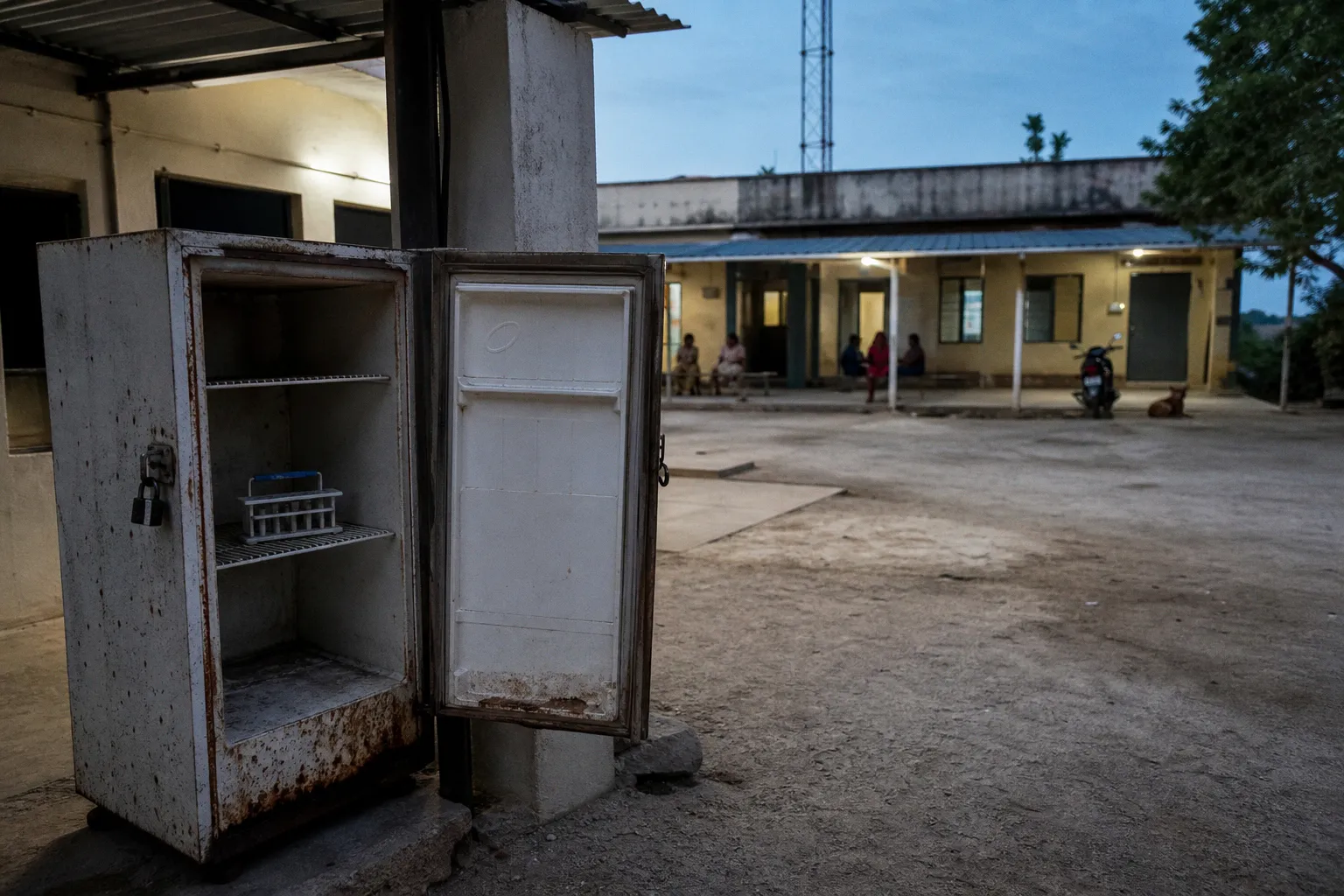
By morning, the cabinet display is above the +8°C line and the PHC is holding vaccines meant for an entire catchment area. At that point, the problem is no longer a power cut. It is a vaccine-preservation operation with a narrow margin for error.
This is why rural PHC cold chain vaccine storage guidelines cannot be treated as a folder of instructions that gets opened after something goes wrong. The system already has a response framework: RI Form 16, the facility contingency plan, temperature monitoring, cold boxes, conditioned ice packs, and a designated route to another functional cold chain point. What decides the outcome is whether those pieces are usable at midnight, by the staff actually on duty.
The RI Form 16 Protocol: Mandatory Emergency Preparedness
RI Form 16 is the part of routine immunization planning designed for the moment routine stops being routine. Every cold chain point needs a written contingency arrangement for vaccine storage during equipment failure, power interruption, repair work, flooding, transport disruption, or any other event that leaves the ILR unable to maintain the required range.
The document matters because it settles decisions that should not be negotiated during an outage. It identifies the designated Cold Chain Handler, the officer who can initiate transfer, the nearest functional cold chain facility, contact numbers, transport arrangements, and alternate destinations if the first facility is unavailable.
A workable plan answers practical questions in advance:
- Who receives the temperature alert after working hours, and who is the second contact if that person cannot respond?
- Which cold box is available, where are the ice packs, and who knows how to condition them correctly?
- Which nearby PHC, CHC, or district store can receive stock immediately?
- What vehicle can be called at night, during rain, or when the routine transport arrangement is unavailable?
- Who records the excursion, the transfer time, the vaccine details, and the final decision on usability?
The critical word is not “written.” It is “operational.” A signed form in a cabinet does not move vaccine stock. Staff need to know where the form is, who has the keys, which phone numbers still work, and how long the actual route to the alternate facility takes when the road is bad.
The contingency plan should also make clear that the medical officer’s absence does not pause the response. In a genuine vaccine cold chain failure at a PHC, waiting for a senior officer’s approval can consume the very holdover time that the cold box was meant to provide.
The emergency plan is not a document for the inspection day. It is a permission structure for acting quickly when the cabinet temperature starts moving.
Mock drills are useful precisely because they expose the details that polished paperwork conceals. A drill held during normal hours may show that staff understand the sequence. A drill based on an early-morning outage, an absent medical officer, and one unavailable contact person shows whether the sequence survives reality.
Real-Time Monitoring and the Role of eVIN Alerts
The Electronic Vaccine Intelligence Network, or eVIN, changed one important part of the rural cold chain: it made temperature deviation visible before the facility opens for the day.
In vaccine storage centres equipped with SIM-enabled temperature loggers, the system monitors the temperature of ILRs and other mapped equipment and can send alerts when the unit moves outside the prescribed range. For a PHC, this turns a silent overnight excursion into a signal that somebody can act on. That is a substantial operational advantage, but only if the alert reaches a person with both authority and access.
The useful question is not whether the logger is installed. It is whether the alert chain is alive.
A functioning chain has several links:
1. The temperature logger is powered, connected, and correctly associated with the relevant equipment.
2. The registered mobile numbers belong to staff who are still posted at the facility or available for escalation.
3. The Cold Chain Handler understands what the alert means and does not treat it as an IT notification for someone else.
4. The handler has access to the cold chain room, cold boxes, ice packs, and the emergency contact list.
5. The district vaccine logistics team has a clear path for escalation when the local facility cannot stabilize the situation alone.
This is where monitoring systems can be misunderstood. eVIN does not protect vaccines by itself. It does not condition ice packs, arrange a vehicle, open a locked cold chain room, or decide whether a temperature excursion has affected vaccine usability. It reduces the time between failure and awareness. The facility response must convert that awareness into action.
A practical review after any alert should ask more than whether the unit was repaired. It should ask when the alert was generated, when it was seen, when the cabinet was checked manually, whether the stock was transferred, and whether the event was logged. Those timestamps tell the real story of preparedness.
Temperature Excursion Response: From Cold Boxes to Facility Transfer
When the ILR temperature rises above the recommended upper range, the response should be deliberate and fast. The purpose is not to create activity around the refrigerator. The purpose is to preserve the cold chain while determining whether the ILR can be restored safely.
The first move is to verify the reading. Check the display, temperature logger, power supply, plug, circuit breaker, and door closure. Do not keep opening the ILR in search of reassurance: every opening exchanges stable air for warm room air and shortens the remaining margin.
If the temperature is confirmed to be outside the +2°C to +8°C range, vaccines should be transferred according to the facility contingency plan into a correctly packed cold box with conditioned ice packs. Record the time of the event, the storage temperature observed, the vaccine stock moved, and the time transfer was completed. This record is not administrative decoration. It is needed later to assess the excursion and decide what stock can be released, held, or discarded under programme guidance.
The sequence is simple enough to remember, but it needs discipline:
1. Protect the stock first. Keep the ILR door closed while the cold box is prepared. Do not remove vaccines one tray at a time while staff debate the fault.
2. Use conditioned ice packs. Frozen packs taken directly from a deep freezer can create a freeze risk for freeze-sensitive vaccines. Packs must be conditioned before packing.
3. Separate and pack carefully. Vaccines should be protected from direct contact with ice packs where required. Use the appropriate arrangement inside the cold box and avoid overloading it.
4. Label the transfer. Note the date, time, originating facility, responsible handler, and stock details. A box moved without documentation becomes difficult to manage once it reaches another facility.
5. Communicate early. Inform the receiving cold chain point before departure. A transfer vehicle arriving at a locked store or an unmanned PHC is not a backup plan.
6. Maintain the chain during transport. Keep the cold box closed, shielded from direct heat, and handled as vaccine equipment rather than ordinary cargo.
If the outage is prolonged, the unit cannot be repaired, the cold box is unavailable, or the facility cannot guarantee continued temperature control, vaccine stock must move to the identified alternate cold chain point. The destination may be another functional health facility or the district cold chain store, depending on the local plan and distance.
The transfer decision should not wait until the last hour of holdover capacity. Holdover is a safety margin, not a target. Roads, vehicles, rainfall, staff availability, and a receiving facility’s storage capacity can all turn a short transfer into a long one.
Diluents require their own attention. Diluents for vaccines such as BCG and measles-containing vaccines must not be stored in the deep freezer. They need to be kept at the appropriate refrigerator temperature before use so that vaccine and diluent are handled according to immunization guidance. During an emergency transfer, they should travel with the relevant vaccine stock under the same controlled arrangement, not be left behind on a counter because they are not in the main vaccine tray.
Equipment Limitations: Why Deep Freezers Are Not for Vaccine Storage
The deep freezer has a very specific role in the rural immunization cold chain: it freezes and stores ice packs. It is not an overflow room for vaccines when the ILR is crowded, inconveniently placed, or temporarily unreliable.
That distinction is not semantic. A deep freezer operates well below the refrigerator range. At sub-district level, its use is tied to ice-pack preparation, while vaccine storage is managed in the ILR within the prescribed +2°C to +8°C range for vaccines requiring that range. Putting freeze-sensitive vaccines into a deep freezer can damage them even when vials look perfectly normal afterward.
Some failures are easy to see: a broken seal, a visibly compromised vial, an obvious temperature alarm. Freeze damage is less forgiving because the product may not advertise what happened to it. A vaccine can look intact at the point of administration while its storage history has already become unacceptable.
The distinction also matters during an emergency. When an ILR fails, the deep freezer may still be working. That does not make it a rescue destination for the vaccine trays. It makes it useful for maintaining the supply of ice packs needed to prepare cold boxes and vaccine carriers.
| Equipment | Usual temperature role | Appropriate role at a sub-district facility | Emergency value |
|---|---|---|---|
| Ice-Lined Refrigerator (ILR) | +2°C to +8°C | Storage of vaccines requiring refrigerator-range storage under programme guidance | Primary storage; provides holdover during an outage |
| Deep Freezer (DF) | Around -15°C to -25°C | Freezing and storing ice packs | Supports cold-box preparation, not routine vaccine overflow |
| Large cold box | Maintains a cold environment with conditioned ice packs | Transfer or temporary storage during contingency operations | Useful for longer emergency holding and inter-facility transfer |
| Small cold box | Maintains a cold environment with conditioned ice packs | Outreach support and smaller emergency loads | Useful where volume is limited or stock must be divided |
| Vaccine carrier | Maintains temperature during a session or delivery route | Last-mile transport and session use | Not a substitute for a fully planned prolonged-storage arrangement |
The rural health center solar refrigerators now seen in some locations change the power equation, but they do not change these storage principles. Solar equipment can reduce dependence on unreliable grid supply when correctly installed and maintained. It still needs temperature monitoring, a response plan, clean placement, functional batteries or power components where applicable, and staff who understand what to do if the unit alarms.
A solar refrigerator is resilience infrastructure, not immunity from failure.
Holdover Capacities and Logistics for Vaccine Preservation
Holdover time is the space between failure and loss. It is not fixed in the way staff often imagine. It depends on the equipment model, ambient conditions, the number and condition of ice packs, how the box was packed, whether the lid remains closed, and how often someone opens it “just to check.”
Published cold-box and vaccine-carrier performance figures are usually stated under specified test conditions, including high ambient temperatures. Those figures are useful for planning, but they should not become an excuse to delay transfer. A large cold box generally offers more time and volume than a small cold box; a vaccine carrier is designed for shorter, session-level movement. The facility should know the documented capacity of its own equipment rather than rely on a generic number remembered from training.
The cold chain maintenance checklist India facilities actually need is less about ticking boxes and more about removing uncertainty before an emergency. On an ordinary working day, the handler should be able to establish the following without searching through files:
- the current vaccine stock volume and whether the available cold boxes can realistically hold it;
- the location and usable condition of cold boxes, lids, foam pads, separators, and ice packs;
- the method for conditioning ice packs, including who knows the difference between a frozen pack and a conditioned one;
- the current status of the ILR, deep freezer, power supply, generator, and temperature logger;
- the active contact details for the receiving facility, transport provider, Cold Chain Handler, medical officer, and district logistics staff;
- the route, approximate travel conditions, and access arrangements at the alternate storage point;
- the stock and documentation procedure for recording any temperature excursion.
That first item is often overlooked: phc immunization storage capacity is not merely an inventory issue. It decides whether a contingency plan is physically possible. A facility may have enough cold boxes for an outreach session but not enough for its entire ILR stock. It may have an alternate PHC listed in RI Form 16 but no confirmation that the alternate site has space in its own ILR. It may have a vehicle number but no arrangement for night access.
Those are not minor gaps. They are the difference between a plan and a hope.
Conditioning ice packs deserves particular care. A pack straight from the deep freezer is too cold to place directly against freeze-sensitive vaccines. Conditioning allows the pack surface to warm appropriately while the core remains frozen, reducing the risk that the cold box becomes a freezing chamber. The process needs enough time, staff who recognize the correct condition, and a clean place to stage the packs. It cannot be improvised in the minute after an alarm arrives.
A cold box preserves vaccines only when the packing is right. Otherwise it can turn a heat excursion into a freeze excursion.
The same caution applies to generator backup. “Generator available” is not a meaningful status if the fuel is missing, the battery is flat, the changeover switch is faulty, or no one on the shift can start it. Backup power must be tested under load, not assumed from the fact that a machine sits behind the facility.
The Backup Plan Is a Chain, Not a Machine
Rural PHC cold chain failure is often described as an equipment issue because the failure becomes visible on a refrigerator display. But the refrigerator is only one link.
The real backup plan is a chain of prepared decisions: an alert that reaches a live phone; a handler who can enter the room and act; conditioned ice packs; a cold box that fits the stock; an alternate facility that can receive it; transport that can move; and records that allow the programme to assess the excursion properly afterward.
RI Form 16 gives the facility the structure. eVIN can shorten the time to detection. ILRs, cold boxes, deep freezers, generators, and solar refrigerators provide the equipment layer. None of it works reliably if staff discover the gaps only when the temperature has already crossed the line.
The sensible standard is not perfection. Rural facilities operate with real constraints, weather, distance, turnover, and uneven infrastructure. The standard is readiness that has been tested before the outage: the plan is current, the contacts answer, the boxes are usable, the ice packs are conditioned correctly, and no vaccine is being quietly stored in a deep freezer because the ILR is crowded.
That is how a PHC turns a cold chain failure from a stock-loss event into a controlled transfer.