Leonardo da Vinci Museum Tickets: A Step-by-Step Route to Entry
Ten hours of continuous operation. One hard cutoff at the door. A typical visit that compresses the entire experience into 45 to 60 minutes for self-guided browsing and stretches to 75 to 90 minutes when audio guides or interactive stations enter the picture.
These three variables — operating window, last-entrance threshold, and visit duration — define the narrow operational envelope of the Museo Leonardo da Vinci in Rome. Securing entry requires understanding that envelope before committing money or transit time.
Tickets and prices
- Official ticket — Adultfrom€12
Prices checked on August 16, 2026 · current price on the partner page.
Official website — leonardodavincimuseo.com
- Time to spend: 2–3 h
- Best time to visit: early morning
Prices are indicative and may change — confirm the price and availability on the partner page.
Partner link — GetYourGuide ticketsThe venue sits at Piazza del Popolo, 12, 00187 Roma RM, in the Flaminio quadrant of central Rome. It is not the Museo Leonardiano in Vinci, Tuscany, nor the Leonardo da Vinci National Museum of Science and Technology in Milan. The Rome institution is a compact machine-replica and interactive-exhibit space derived from the master's codices — not a gallery of Renaissance master paintings. That distinction shapes both ticket expectations and visit planning.
Someone searching for how to buy Leonardo da Vinci Museum tickets is therefore solving two problems at once. The first is transactional: which channel offers the right balance of price, flexibility, and convenience? The second is logistical: how much time should be protected around the ticket, and how safely can that time be fitted into a day in central Rome?
Navigating Ticket Options and Pricing Structures
The ticket inventory is segmented across three acquisition channels: on-site purchase at the Piazza del Popolo entrance, online booking through the museum's own reservation system, and third-party resellers that bundle the entry pass into curated tour packages. Each channel carries a different cost ceiling and a different friction profile.
Standard admission on-site and through the museum's direct channels begins at a published base rate that varies modestly by season and channel. Third-party platforms frequently append a service surcharge for the convenience of bundled itineraries, skip-the-line priority, or multilingual guide add-ons. Visitors who arrive without a reservation are not categorically refused entry, but the venue does not publish walk-up wait-time estimates. The absence of a guarantee matters most during peak summer weekends, when a theoretically simple walk-up visit becomes dependent on the flow of visitors already inside.
The question is not simply whether a ticket is available. It is whether the purchase channel gives you something you actually need. A direct booking may be the cleanest option for a visitor who already knows the day and approximate entry time. An on-site purchase leaves the itinerary open, which can be useful when the museum is one stop among several around Piazza del Popolo. A reseller becomes more defensible when the ticket is part of a guided experience or a wider package rather than a standalone admission sold at a marked-up price.
Ticket channel choice determines total cost more than base admission rate — the surcharge between on-site, direct online, and aggregator platforms can exceed the entry fee itself.
| Channel | Typical use case | Cost profile | Reservation required |
|---|---|---|---|
| On-site box office | Walk-up or unplanned visit | Base rate | No |
| Museum direct online | Planned visit on a fixed date | Base rate | Yes |
| Third-party platform | Bundled tour or guided experience | Base rate plus surcharge | Yes |
The table simplifies what is in practice a moving figure. Rates shift by season, group size, and bundling composition. Visitors with reduced-mobility requirements, family groups, or school cohorts should query the venue directly for category-specific rates that may not be surfaced through public listings.
Tour aggregator platforms typically list the same base entry alongside a platform fee. The bundled variants — including skip-the-line access, audio-guide inclusion, or small-group guided formats — represent the primary pricing strata above the standard ticket. That higher price is not necessarily irrational, but it should be read correctly. It is payment for packaging, scheduling convenience, or an added service. It is not evidence that the exhibition itself changes according to where the ticket was purchased.
What to compare before paying
A useful comparison is less about hunting for a nominally cheap ticket and more about matching the purchase to the shape of the day:
- Price: compare the final payable amount, not only the displayed base rate. Service fees and bundled extras can change the total.
- Flexibility: an online ticket may tie the visit to a particular date, time, or booking condition, while an on-site purchase preserves more spontaneity.
- Queue handling: a reseller may advertise priority or skip-the-line access, but the specific benefit should be understood before purchase rather than assumed from the platform name.
- Included services: audio guides, guided tours, and other additions can make a bundled ticket worthwhile for some visitors and unnecessary for others.
- Eligibility: reduced rates and Roma Pass concessions generally need to be handled through the channel that accepts them.
The practical takeaway is blunt: if you buy tickets for Leonardo da Vinci Museum through a third party, you are paying for packaging, scheduling convenience, and sometimes queue avoidance — not for a materially different museum experience. The base exhibition is the same regardless of channel. The question is whether the premium buys enough operational certainty to justify the margin.
Daily Operating Hours and Last Admission Deadlines
The confirmed operating window is straightforward: 10:00 AM to 8:00 PM, seven days a week. The last entrance is fixed at 7:15 PM — 45 minutes before the venue closes its doors for the day. This cutoff is rigid. Visitors arriving after 7:15 PM are not admitted regardless of ticket type or prior purchase.
The arithmetic matters for planning, but the closing time should not be mistaken for a recommended arrival time. A visitor entering at 6:30 PM has 90 minutes of remaining operating time before the museum closes at 8:00 PM. That can be enough for a self-guided browse, but it leaves less room for a complete audio-guide circuit or prolonged interaction with the exhibits. A visitor entering at 10:00 AM has the full operating window available, although the typical visit consumes only a fraction of that capacity.
The last-admission rule creates two separate deadlines. The first is the published cutoff: 7:15 PM. The second is the personal deadline required by the kind of visit you intend to make. Someone interested in a quick look at the main machines can work closer to closing than someone who wants to listen to every audio-guide track, operate the interactive replicas, and read the explanatory panels.
For visitors calibrating entry time against the 8:00 PM close:
1. For a full audio-guide circuit: target an entrance early enough to leave roughly 75 to 90 minutes for the visit, rather than treating the last-admission time as a usable start time.
2. For a focused self-guided browse: a later entry can work, provided the visitor is comfortable with a shorter and more selective route.
3. For every ticket type: treat 7:15 PM as a firm boundary, not as a grace period.
This distinction is particularly important for travelers arriving from another part of Rome. A ticket may be valid, but validity does not compensate for a delayed departure, a missed connection, or time spent finding the entrance around the piazza. The safest plan is to arrive in the area with a margin, then use the remaining time to orient yourself rather than attempting to calculate the journey against the final admission minute.
The museum does not publish crowd-density data by hour. General Rome tourism patterns suggest that weekdays outside the peak summer season tend to draw fewer visitors than weekend afternoons, but the venue itself does not confirm or characterize peak periods. Visitors seeking quieter conditions can use that general pattern as a working hypothesis without treating it as a guaranteed formula.
Strategic Planning for Your Museum Visit Duration
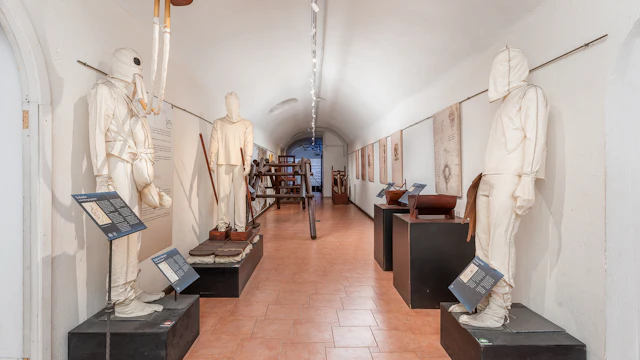
The venue is compact. Certified reproductions of Leonardo's mechanical designs and interactive working-machine replicas occupy the exhibition floor, not original Renaissance canvases. Visitors expecting an art-gallery cadence may overrun their time budget; visitors expecting a large science-museum circuit may find that the route concludes sooner than anticipated. Typical visit durations run 45 to 60 minutes for self-guided browsing and 75 to 90 minutes with audio guides or interactive stations. This range, drawn from visitor reporting, is the planning baseline. The museum itself does not issue an official dwell-time estimate.
The most useful way to read that range is as a choice of intensity rather than a promise of duration. A short visit can cover the principal concept of the museum: Leonardo's designs translated into physical models that can be inspected, compared, and, in some cases, operated. A longer visit gives the visitor time to slow down at the mechanisms, follow the explanatory material, and engage with the interactive elements instead of moving through them as visual displays.
Three variables tend to stretch the baseline upward:
- Audio-guide engagement adds noticeable time per visitor, depending on listen-through rate at each station. Visitors who follow every narration track end closer to the longer end of the range.
- Interactive-station use increases dwell time at individual replicas. The heavier mechanical designs — the self-propelled cart, the aerial screw, and the robotic knight — attract longer engagement than smaller-scale models.
- Group size changes the rhythm of the visit. Members take turns operating replicas, reading panels, and moving between stations, so the group’s pace becomes slower than that of a solitary visitor moving independently.
Three variables compress the visit:
- Prior familiarity with the codices reduces interpretive dwell at signage stations. A visitor who already understands the flying-machine concepts may read selectively and move on.
- No audio guide removes the need to stop for a narration track at each point of interest.
- Selective routing allows visitors to concentrate on the most central machines and pass through less prominent interactive areas without treating every station as mandatory.
That last point is where the original planning problem often appears. It is tempting to assign a fixed number of minutes saved for every cluster omitted, but the actual result depends on the visitor’s pace, the number of people at a station, and the amount of reading or hands-on activity involved. A selective route should therefore be understood qualitatively: it can shorten the visit, but the amount of time saved is variable rather than fixed.
A visitor planning approximately one hour should enter without an audio guide or should be prepared to listen selectively. The sensible priority is to protect time for the main interactive clusters rather than attempt to complete every available explanation. A visitor planning closer to 90 minutes can include the audio guide, allow for slower movement between replicas, and spend more time on the machines that reward inspection from several angles.
The 45-to-90-minute total range is consistent across visitor reporting and works as a useful planning bracket for anyone building a multi-stop Rome itinerary around the museum slot. It should not be treated as a performance target. The point is to avoid two opposite mistakes: booking the museum as though it required half a day, or arriving shortly before closing and expecting to absorb the full exhibition without selecting what matters most.
The museum rewards deliberate pacing, but it does not require an entire afternoon. Plan for the kind of attention you want to give the machines, not for an abstract ideal of seeing everything.
Matching the visit to the rest of the day
Piazza del Popolo makes the museum easy to combine with other central-Rome stops, but that convenience can also create unrealistic schedules. A visitor who places the museum between two timed attractions should account for the fact that the exhibits encourage pauses. The route may be compact, yet a mechanical replica is not experienced in the same way as a painting viewed from a fixed distance. Visitors often stop to understand how a design is supposed to function, wait for access to an interactive station, or return to a model after reading its description.
For that reason, the ticket slot should be treated as a protected block rather than as a narrow appointment that ends the instant the visitor crosses the threshold. Add time for arrival in the piazza, locating the entrance, and moving onward afterward. The amount of buffer needed depends on the rest of the itinerary and the visitor’s tolerance for running between appointments, but a plan with no margin is fragile even when the museum itself is easy to reach.
Public Transit Routes to Piazza del Popolo
Piazza del Popolo is one of the most transit-accessible areas in central Rome. Multiple public-transport options converge close to the museum entrance, making the venue reachable from several directions without requiring a long cross-city transfer.
| Mode | Route | Stop or destination | Walk to entrance |
|---|---|---|---|
| Metro | Line A | Flaminio | Short walk |
| Tram | No. 02 | Piazza del Popolo area | Short walk |
| Bus | 89 | Piazza del Popolo area | Short walk |
| Bus | 61 | Piazza del Popolo area | Short walk |
| Bus | 495 | Piazza del Popolo area | Short walk |
| Bus | 490 | Piazza del Popolo area | Short walk |
| Bus | 117 | Piazza del Popolo area | Short walk |
The table is best read as a route map, not as a set of guaranteed walking measurements. The distance from a stop to the entrance can feel different depending on the exit used, street conditions, crowds in the piazza, and whether the visitor is moving with luggage, children, or a group. Allow extra time according to your pace rather than building the connection around an exact number of minutes.
The Flaminio metro stop on Line A is the highest-capacity option and often the most straightforward route for visitors staying south of the city center or arriving from Termini Station. It places travelers in the Piazza del Popolo area without requiring them to navigate a long surface route. The exact journey time still depends on the starting point, platform access, service conditions, and the time required to reach the correct exit.
Tram 02 is another convenient option for visitors approaching the piazza from its service corridor. Bus routes 89, 61, 495, 490, and 117 provide additional connections, although their reliability is more exposed to street traffic and temporary diversions than a metro journey. A route that looks direct on a map may still take longer than expected when traffic, boarding conditions, or a crowded stop enters the calculation.
The transport decision should therefore be made in relation to the admission deadline:
- Metro Line A: a strong default when the route connects naturally with your starting point and you want to reduce exposure to road traffic.
- Tram 02: useful when its line matches the direction of travel and the service is operating normally.
- Bus routes: practical for direct access from particular neighborhoods, but worth checking against current traffic and service conditions.
- Walking: reasonable for visitors already in the historic center, especially when the walk forms part of the day’s sightseeing rather than a race to the museum.
Driving to the venue is not recommended. The Piazza del Popolo area falls within a ZTL, or limited traffic zone, restricted to residents and authorized vehicles. Non-resident drivers entering the zone are subject to administrative fines. Parking in the immediate vicinity is limited to paid private garages with hourly rates that vary by demand.
The transit picture, then, is simple: Metro Line A to Flaminio for a direct central connection, Tram 02 or the cluster of bus routes when they fit the wider itinerary, and walking when the visitor is already nearby. If you are working out how to buy Leonardo da Vinci Museum tickets and build a visit around public transport, Flaminio removes much of the uncertainty associated with reaching the piazza. It does not remove every variable: allow time for the route from the platform or stop, orientation at street level, and the walk to the museum door.
That qualification matters more than it may seem. A ticket plan based on a precise platform-to-door estimate leaves no room for the ordinary friction of Rome: a crowded carriage, a less convenient station exit, a bus that is delayed by traffic, or a visitor who needs to stop and check the route. A short walk is still a walk, and it belongs inside the arrival calculation.
Utilizing Roma Pass and Concessionary Discounts
The Roma Pass qualifies holders for a reduced admission rate at the museum entrance. The discount is applied at the on-site box office; visitors cannot redeem the concession through third-party online platforms that have already charged a non-discounted rate.
The mechanics are straightforward. Roma Pass holders present the physical card or digital equivalent at the ticket desk. The cashier verifies validity, applies the published concession rate, and issues the entry ticket in the same transaction. This is a point-of-sale interaction: the pass reduces the Leonardo da Vinci Museum entry fee at the moment of purchase, not through a separate online workflow.
That procedure creates a simple but consequential choice. A visitor who wants to use the Roma Pass should plan to buy through the channel that recognizes the pass. Purchasing online through a platform that does not apply the concession may lock the traveler into a full-price transaction. The attraction may still admit the visitor, but the pass does not automatically transform an already-issued ticket into a discounted one.
Beyond the Roma Pass, the museum applies standard concession categories:
- Minors within the defined age bands: eligibility and the relevant reduced rate depend on the age category applied by the venue.
- Students: valid international student identification may be required at the point of sale.
- Seniors: the published age threshold determines whether the concession is available.
- Groups: a reduced rate may apply once the party reaches the venue’s published minimum headcount.
Each category carries a rate ceiling distinct from the standard adult ticket. The venue does not publish a single comprehensive concession table; visitors in any of the above categories should confirm eligibility and current rates by direct contact with the box office before arrival.
The Roma Pass reduces cost only at the on-site transaction — third-party tickets already issued at full price are not retroactively discounted, and aggregator bundle rates do not stack with the pass.
For anyone researching Leonardo da Vinci Museum Rome tickets alongside the Roma Pass, the critical sequencing point is this: decide which channel you are using before you commit. Buying a full-price ticket through an aggregator and then presenting a Roma Pass at the door does not produce a refund of the difference. The two systems operate independently, and the on-site discount applies only when no prior purchase has been made through a non-discount channel.
When the discount is not the only consideration
A reduced ticket price is not automatically the cheapest overall arrangement. The calculation depends on whether the visitor already owns a Roma Pass, whether the pass is being purchased for other attractions, and whether the convenience of a direct online reservation matters more than the concession. A traveler buying the pass solely to reduce the museum admission may reach a different conclusion from someone using it across a broader Rome itinerary.
The same logic applies to reseller bundles. A guided package may cost more than a standard ticket but provide an organized entry process or interpretation that a self-guided visitor does not need. Conversely, a visitor who wants only to enter, move independently, and leave within an hour may be paying for services that add little value.
The important distinction is between the museum’s admission price and the total price of the day’s arrangement. Ticket channel, transport, guide format, and pass eligibility interact. Treating any one of them in isolation produces a misleading comparison.
Final Planning Calculus
Three variables determine whether a visit succeeds on operational terms: ticket channel, entry time, and transit mode. The ticket channel sets the cost ceiling and the reservation friction. The entry time, measured against the 7:15 PM last-entrance cutoff and the 8:00 PM close, determines the usable visit window. The transit mode determines the amount of arrival uncertainty introduced by the journey.
Visitors who book through the museum’s direct online channel, arrive via Metro Line A to Flaminio, and enter early in the day typically minimize both cost and risk. That is not a universal formula, but it is a coherent default for a traveler who values predictability. Visitors who book through a third-party platform with a guided-tour add-on pay a premium but gain a structured schedule that locks in a specific entry arrangement. Visitors holding a Roma Pass and arriving on foot from a central hotel may minimize cost at the point of sale, although they should still allow for the possibility of a busier box office or a slower walk through the piazza.
The venue does not present the same operational complexity as the Vatican Museums or the Colosseum. The Leonardo da Vinci Museum in Rome operates within a straightforward, predictable envelope: ten hours open, one hard cutoff, a 45-to-90-minute visit baseline, and a transit network that delivers visitors to the Piazza del Popolo area from multiple converging lines. For anyone still weighing how to buy Leonardo da Vinci Museum tickets, the decision matrix is narrower than it first appears:
1. Choose the purchase channel according to whether you need flexibility, a direct reservation, a concession, or a packaged experience.
2. Match the entry time to the intended dwell. A late arrival may work for a selective browse, but it is a poor fit for a complete audio-guide circuit.
3. Use a route with enough margin. Metro Line A, Tram 02, bus services, and walking connections all have different kinds of uncertainty.
4. Treat the last-admission time as absolute. A valid ticket cannot compensate for arriving after the door closes to new visitors.
5. Protect the experience itself. The museum is compact, but the machines are not a box to be checked at speed. Leave room to stop where the exhibition earns your attention.
The closing point is structural. The museum processes visitors within a finite daily window. The visitor who aligns ticket channel, entry time, and transit mode to that window completes the visit without unnecessary friction. The visitor who treats the venue as interchangeable with the larger Rome museum circuit arrives misaligned and adjusts on the ground, usually at the cost of either a shortened visit or a missed last-entrance slot.
For most travelers, the best ticket is not the one with the most impressive label or the highest advertised convenience. It is the one that fits the actual day: a direct booking when certainty matters, an on-site purchase when flexibility matters, a Roma Pass transaction when the concession is relevant, and a third-party package only when its added services justify the surcharge. Once that choice is made, the rest is disciplined planning rather than guesswork.
Practical info
Currency: EUR
Driving: on the right
Emergency number: 112