Calcium and iron supplements: how to space them?
The calcium and iron tablet interval during pregnancy is not a small detail to leave to memory.
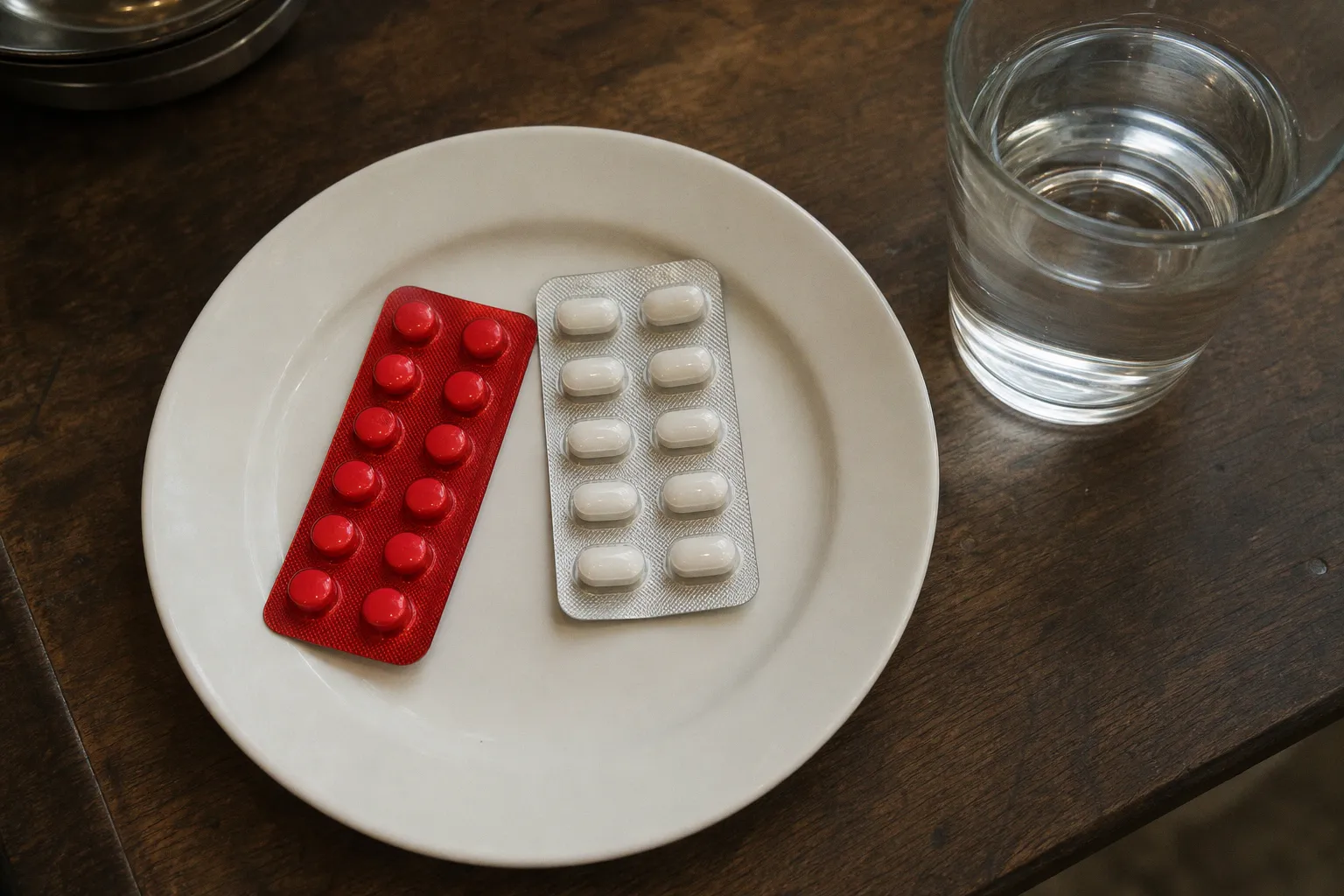
Calcium and Iron Supplements: How to Space Them During Pregnancy
It is a delivery failure built into an otherwise sound antenatal package: a woman receives her IFA tablets, receives calcium, is told to take both daily—and then swallows them together after dinner because that is the only reliable routine she has.
The tablets are present. The supply chain has worked. The clinic has documented distribution. But the absorption plan has collapsed.
Calcium can reduce iron absorption substantially when both are taken at the same time—by as much as 60% in some settings. That matters in pregnancy, when iron demand rises, anaemia is common, and a missed benefit today can become fatigue, poor tolerance of blood loss, or a harder delivery tomorrow. The fix is basic, cheap, and operational: keep iron and calcium at least two hours apart.
India’s antenatal supplementation regimen is designed around this separation. The failure is rarely the medicine itself. It is usually the timetable.
Iron and calcium are both necessary. Taking them together does not make the regimen stronger; it makes the iron dose work less efficiently.
Why calcium and iron compete
Iron and calcium do different jobs, but they meet in the same digestive system. Iron supports haemoglobin production and helps the blood carry oxygen. Folic acid supports cell development and helps prevent neural tube defects. Calcium supports maternal bone health and fetal skeletal development, while vitamin D3 helps calcium absorption.
The problem begins when calcium enters the gut alongside iron. Calcium interferes with iron absorption, especially the non-haem iron supplied through standard iron-folic acid tablets and many plant-based foods. This is not a toxic reaction. Nothing dramatic happens in the stomach. There is no immediate danger signal. The loss is quieter: less iron gets absorbed.
That is why taking calcium and iron together in pregnancy is a poor routine even if it feels efficient.
The standard Indian antenatal regimen from the second trimester is substantial:
| Supplement | Standard daily amount | Operational rule |
|---|---|---|
| IFA tablet | 60 mg elemental iron + 500 µg folic acid | Take separately from calcium, milk, tea, coffee, and antacids |
| Calcium tablet | 500 mg elemental calcium + 250 IU vitamin D3 | Take with a meal |
| Total calcium | 1,000 mg daily, usually as two tablets | Split into two 500 mg doses |
| Duration | At least 180 days from 14 weeks of pregnancy | Build a repeatable daily routine |
The two calcium tablets should not be swallowed together. A single large calcium dose is absorbed less efficiently once it exceeds roughly 500–800 mg, and doubling up also creates a larger obstacle for the day’s iron dose.
This is where household advice often becomes unhelpful. “Take all your pregnancy medicines after food” sounds simple. It is also incomplete. A woman needs an actual schedule, not a slogan.
The national regimen: one IFA tablet, two calcium tablets, three separate moments
Under Indian guidance, supplementation generally starts from the second trimester—around 14 weeks—and continues daily for at least 180 days. The package includes one IFA tablet and two calcium tablets each day.
That creates a three-dose system:
1. One calcium tablet with the morning or afternoon meal. Taking calcium with food reduces gastritis and makes the tablet easier to tolerate.
2. One IFA tablet at least two hours after a meal. This should sit at least two hours away from calcium tablets, milk, curd, tea, coffee, and antacids.
3. The second calcium tablet with the evening meal or later meal. Again, it should remain at least two hours away from the iron tablet.
The two-hour interval is the floor, not an aspirational target. If the gap becomes three or four hours because of work, household schedules, nausea, or meal timing, that is fine. The purpose is separation, not a rigid clock.
A common implementation error is to tell women “take iron at night.” That can work, but only if the evening calcium dose is not also scheduled at night. In many households, dinner, milk, calcium, and IFA all get compressed into one final task before sleep. The routine is convenient. The absorption is not.
A workable daily schedule
There is no single perfect clock-time schedule for every pregnant woman. Agricultural work, factory shifts, long travel to a facility, nausea, fasting practices, and household meal patterns all change the shape of a day. But the sequence must stay intact.
Here are practical examples.
| Daily pattern | Calcium dose 1 | IFA dose | Calcium dose 2 |
|---|---|---|---|
| Regular daytime meals | With breakfast | Mid-afternoon, at least 2 hours after lunch | With dinner |
| Early dinner routine | With breakfast | Mid-afternoon or early evening, separated from meals and dairy | With dinner |
| Nausea with morning tablets | With lunch | Before sleep, at least 2 hours after dinner and calcium | With evening snack or dinner |
| Work outside the home | With breakfast | Carried in a small container and taken mid-shift with water or citrus drink | With dinner |
The exact time is less important than the spacing logic. Calcium stays with meals. IFA gets its own protected slot.
For women who cannot tolerate IFA on a nearly empty stomach, a small non-dairy snack may be more realistic than abandoning the tablet. A programme that demands a perfect absorption environment but produces vomiting and non-adherence has not solved the problem. It has merely moved it.
Food and drink can quietly undo the iron dose
The calcium tablet is not the only source of interference. A routine cup of tea can be enough to weaken an otherwise well-timed IFA dose. So can coffee, milk, curd, and many antacids.
This does not mean pregnant women should avoid nutritious foods or stop drinking milk. Calcium-rich foods remain useful. The job is to keep them away from the iron tablet by at least two hours.
The practical split looks like this:
- Take IFA with water whenever possible. This is the simplest, lowest-risk option.
- Use vitamin C strategically. Orange, lemon water, amla, guava, or other vitamin C-containing foods can support iron absorption when taken around the iron dose.
- Keep tea and coffee out of the IFA window. A tea habit immediately after meals is common and difficult to change, so it may be easier to move the IFA dose than to fight the entire household routine.
- Separate milk, curd, paneer, and calcium-fortified drinks from IFA. They do not need to disappear from the diet. They need a different time slot.
- Keep antacids away from IFA if possible. Women using regular antacids for reflux should ask their antenatal clinician or pharmacist to help build a schedule that does not sacrifice iron absorption.
Do not cut milk or calcium foods from pregnancy meals. Move them away from the iron tablet. That is a scheduling problem, not a nutrition ban.
The distinction matters. Maternal nutrition counselling often becomes a list of prohibitions, and women are left with less food, more anxiety, and no workable routine. The correct instruction is more precise: protect the iron dose for two hours on either side from calcium supplements and calcium-rich drinks or foods when feasible.
What fails at facility level—and how to fix it
From a systems perspective, this problem is predictable. Tablets are distributed in a packet. A counselling message is delivered once. The household must then convert that packet into a daily schedule without a visual plan, a reminder tool, or any follow-up on timing.
Coverage data may show that IFA and calcium were received. It rarely shows whether they were separated by two hours. That is the blind spot. Distribution is not consumption; consumption is not correct consumption.
The bottlenecks are familiar:
- One vague instruction for three tablets. “Take these every day” is not a dosing schedule.
- No distinction between meal-linked and non-meal-linked tablets. Calcium is placed with food; IFA should be protected from calcium and often taken two hours after a meal.
- No response to side effects. Constipation, nausea, acidity, and dark stools can push a woman to stop treatment silently.
- Packets without a daily sequence. Three tablets of similar size become three tablets to take together.
- Counselling aimed only at the pregnant woman. In many homes, someone else prepares meals, keeps medicines, or decides when tea and milk are served.
The repair does not require an app, a new procurement contract, or a policy seminar. It requires a better last-mile instruction.
At antenatal care visits, ASHAs, ANMs, and facility teams can give a simple spoken sequence: calcium with breakfast, iron in the afternoon, calcium with dinner. Then ask the woman to repeat it back in her own words. If her household eats only twice daily, redesign the sequence with her. If she works outside, identify the IFA slot she can actually sustain.
A medicine packet can also be marked by time of day: morning meal, afternoon iron, evening meal. That is not sophisticated health technology. It is basic error-proofing.
Side effects are not a reason to merge the doses
Iron-folic acid tablets can cause nausea, constipation, abdominal discomfort, or dark stools. Calcium can also cause gastric discomfort in some women. When side effects occur, the temptation is obvious: take every tablet once, after the biggest meal, and get it over with.
That solution is understandable. It also defeats the spacing plan.
A more durable approach is to troubleshoot the specific failure point.
If IFA causes nausea
Try moving the IFA tablet later in the day, such as before sleep, while preserving the two-hour gap after dinner and calcium. Some women tolerate the tablet better after a small light snack rather than on a fully empty stomach. The priority is not forcing a textbook-perfect moment that makes the woman vomit. The priority is retaining daily iron exposure without calcium interference.
If constipation becomes a problem
Increase fluids where available, add fibre-rich foods, and maintain movement as pregnancy permits. Do not quietly discontinue IFA for a week and assume the clinician will know. Constipation is common, but a long interruption in iron intake is a genuine loss in an anaemia-prevention programme.
If heartburn requires antacids
This needs a schedule review, not guesswork. Antacids can interfere with iron absorption. A clinician, pharmacist, ANM, or obstetric team can help position the products at separate times. Women should not stop prescribed medicines on their own, especially when symptoms are persistent or severe.
If the tablets are repeatedly missed
Do not solve missed doses by doubling the next day’s intake unless a clinician specifically advises it. The regimen works through steady, repeated dosing across pregnancy. One missed tablet is a disruption; turning the next day into a pile-up of tablets can create more side effects and more confusion.
A schedule that survives real life
The maternal calcium supplementation schedule must fit the household, not an idealised clinic day. The best schedule is the one a woman can repeat for 180 days without mixing the doses, without severe gastric distress, and without depending on a health worker to remind her every evening.
For most women, the reliable design is straightforward:
- First calcium tablet with the first substantial meal.
- IFA tablet in a protected slot at least two hours later, away from tea, coffee, milk, curd, calcium tablets, and antacids.
- Second calcium tablet with the evening meal.
- Two calcium tablets split across the day, not taken as one 1,000 mg dose.
- If the routine does not fit, redesign the timing with the antenatal team instead of taking all tablets together.
This is not an abstract compliance issue. It is a small piece of maternal health infrastructure operating inside a kitchen, a workday, and a pregnancy already carrying too many demands. The supply chain gets the tablets to the woman. Clear timing gets the benefit into her body.
The two-hour gap is the simplest part of the system. It should also be the part that never breaks.