Primary health center medical supply chain gaps behind rural drug shortages
India’s rural drug shortage is not reducible to a single national stock-out percentage. No current, comparable national rate exists across primary health centers.
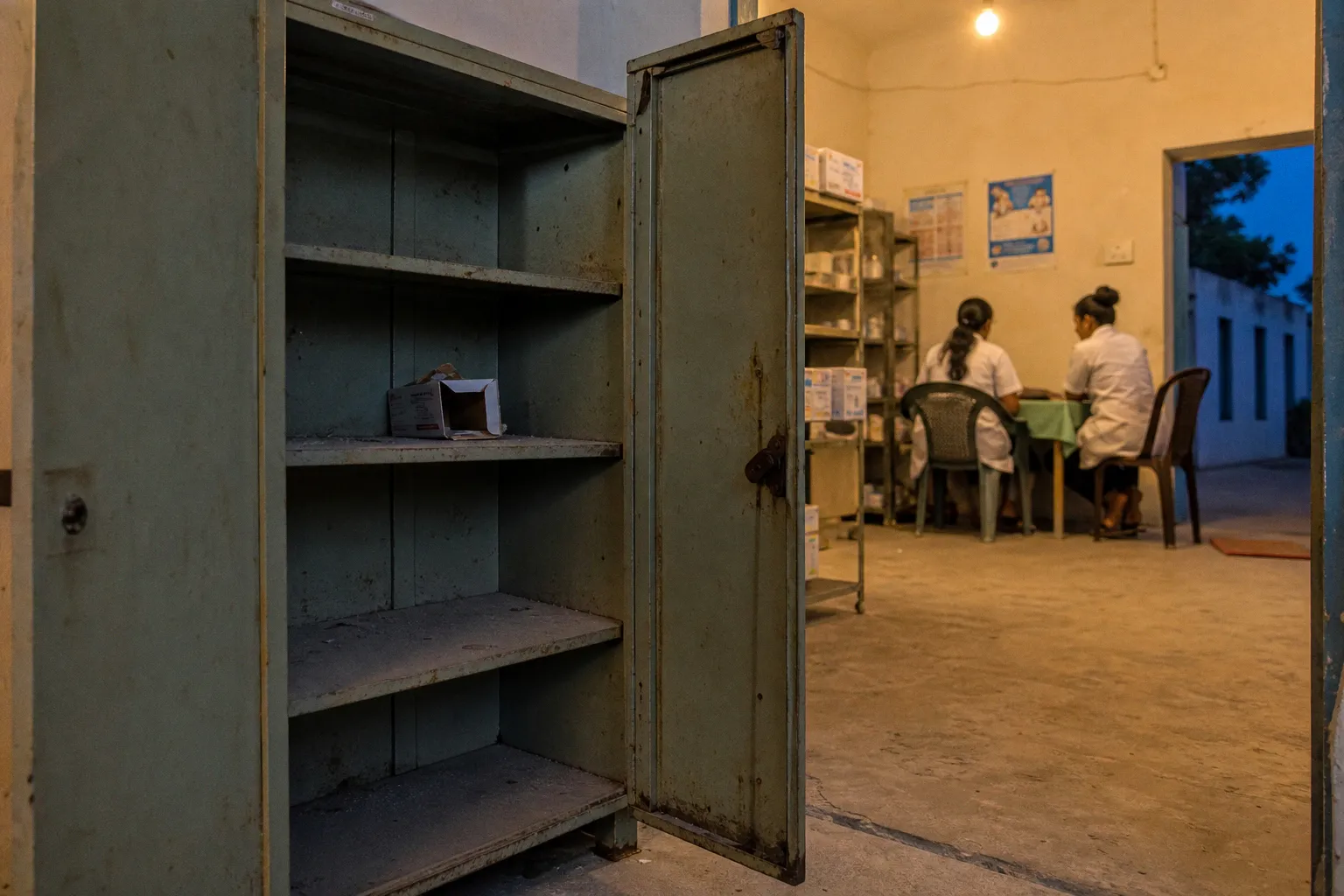
The available audits show a more operational problem: medicines can be listed, ordered, purchased, and digitally indented without being available to the patient at the facility counter.
The primary health center medical supply chain bottlenecks India faces are therefore sequential. Demand is estimated poorly. Procurement is delayed. Warehouses lack segregation and cold-chain resilience. Transport is improvised. Digital systems record an indent but not necessarily a dispense, a consumption trend, an impending expiry, or a stock-out. By the time the gap becomes visible, the facility often has only two options: local purchase or referral of the cost to the patient.
This is not a marginal administrative defect. Medicines have historically been a major driver of household health expenditure in India. The share of total health expenditure paid out of pocket declined from 64.2% in 2013–14 to 39.4% in 2021–22, according to figures cited in the 17th Common Review Mission. The direction is positive. A missing medicine at a PHC still transfers cost from the public system to the household.
Digital inventory systems record movement, not always availability
The National Health Mission has pushed facility-level essential medicine lists for years. Its Free Drugs Service Initiative operational guidelines were issued in 2015. Subsequent communications covered facility-wise essential drug lists and the implementation of the Drug and Vaccine Distribution Management System, or DVDMS, through the drug-distribution-counter level.
The architecture is reasonable. A digital inventory platform should connect four records:
1. The opening balance at the facility.
2. The quantity received from the warehouse or higher facility.
3. The quantity dispensed to patients.
4. The consumption rate that determines the next indent.
If any one of these records is incomplete, the dashboard stops representing physical inventory. It becomes an administrative ledger.
The 17th Common Review Mission’s findings from Uttar Pradesh illustrate the distinction. Reviewed facilities reported approximate essential-medicine availability of 70–80%. DVDMS was used for drug indenting. However, peripheral facilities had limited recording of dispensing and consumption. This prevented reliable real-time visibility of stock at the point where medicines were actually issued.
The number should be interpreted narrowly. It is not an India-wide PHC availability estimate. It is a finding from reviewed facilities in one state. Its value lies in identifying the failure mode: an electronic indenting system can coexist with incomplete inventory control.
Uttarakhand shows the same pattern in a different configuration. The state’s Essential Drug List for AAM-PHCs included 135 medicines. In reviewed AAM-PHCs, availability ranged from 54 to 80 medicines against the 134-medicine comparison list used in the review. e-Aushadhi/DVDMS had reached the SHC-AAM level, but its use was concentrated on raising indents. Monitoring of stock-outs, near-expiry stock, and broader inventory conditions remained limited. Staff capacity to operate the system was also identified as a constraint.
A supply platform that captures requests but not consumption does not forecast shortage. It documents it after the fact.
This distinction matters for rural hospital medical inventory tracking. A facility may appear digitally connected while the pharmacist, nurse, or health worker maintains the actual operating picture through registers, phone calls, and direct collection of stock from a higher facility. The data system is then an additional process, not the mechanism that governs replenishment.
A functional district dashboard requires more than facility login coverage. It requires a minimum dataset that is complete at facility level:
- dispensing entries captured at the distribution counter, not only receipts at the store;
- stock balances reconciled against physical counts at defined intervals;
- consumption calculated over a usable historical period, with seasonal adjustments where relevant;
- automated flags for zero stock, minimum stock, and products approaching expiry;
- visibility into stock held at the district warehouse, the transit stage, and the facility;
- exception reporting when a facility submits repeated emergency indents or makes local purchases.
Without these fields, a district may report digital implementation while retaining analogue uncertainty.
Procurement and forecasting fail before the PHC receives anything
A stock-out at a PHC is often described as a facility problem. The audit trail frequently starts much earlier.
The Comptroller and Auditor General’s audit evidence from Chhattisgarh found 128 essential drugs across 30 categories stock-out at five test-checked warehouses. The duration ranged from one day to 1,826 days. That interval is consequential. A one-day gap can be absorbed by a buffer stock or a nearby facility. A gap extending over years indicates that the normal replenishment system has ceased to function for that item.
The audit also found that annual facility indents were revised at district and directorate levels without recorded justification or analysis of consumption. This is the central forecasting trap. An indent is not demand merely because it is submitted by a facility. It may be an estimate based on last year’s allocation, an informal ceiling, a shortage-adjusted request, or a number edited after it leaves the facility.
A demand forecast should distinguish between at least three quantities:
| Parameter | What it measures | Failure if it is substituted for another measure |
|---|---|---|
| Reported indent | What the facility requests | Can reproduce past under-supply or be revised without evidence |
| Recorded consumption | What was actually dispensed | Becomes unreliable when dispensing is not entered consistently |
| Unmet demand | What patients needed but did not receive | Disappears from the dataset when patients buy privately or leave without treatment |
| Warehouse stock | What is physically held upstream | Does not prove availability at the PHC counter |
| Lead time | Time from approved order to facility receipt | Conceals seasonal failure when averages mask late delivery |
The missing variable is often unmet demand. If a PHC has no antibiotic, antihypertensive, iron-folic acid supplement, or other listed medicine, recorded consumption falls. A naïve forecasting model may interpret this as lower demand. It is not lower demand. It is suppressed dispensing.
Tender timing compounds the error. The Chhattisgarh audit warned that delayed tender finalisation could make annual demand estimates irrelevant. Medicines with seasonal use may arrive after the period of need. Procurement can be technically completed while service delivery has already failed.
The correct question for district health facility stockout reasons is therefore not simply, “Was a purchase order issued?” It is more specific:
- Was the forecast based on consumption adjusted for previous stock-outs?
- Were changes to facility indents documented and analytically justified?
- Did tender finalisation occur early enough for seasonal demand?
- Was the supplier’s delivery schedule measured against the facility’s required date, not only the contract date?
- Did the district maintain a defined buffer for products with volatile or seasonal consumption?
Each is a measurable control. None requires a speculative explanation.
Warehouses are not passive storage points
Warehouse performance determines whether procured medicines become usable facility stock. Audits show that this conversion can fail through basic infrastructure defects.
In Uttar Pradesh, the Common Review Mission recorded warehouse problems including inadequate racks, mixed storage of expired and active stock, non-functional walk-in coolers, and lack of power backup. These are not cosmetic deficiencies. They affect stock integrity, traceability, and the ability to apply first-expiry, first-out procedures.
The Chhattisgarh audit identified quality-control reporting delays ranging from 43 to 265 days. A delayed test report creates a planning problem even where physical stock exists. Goods may be held pending clearance, facilities may be uncertain about issue status, and purchase planning may proceed without a reliable view of usable inventory.
Warehouse management has four separate tasks. They should not be conflated.
Storage capacity
Medicines require adequate shelving, segregation, and environmental conditions. Stock placed on floors, mixed with expired items, or kept in unreliable temperature-controlled spaces cannot be treated as fully available stock. The physical count may be positive. The usable balance may not be.
Batch and expiry control
A warehouse must identify which batch should move first and which facility can consume it before expiry. This requires batch-level records and consumption data from recipient facilities. Without them, issue decisions are based on warehouse congestion rather than expected use.
Quality release
Quality testing and administrative release should occur within a timetable compatible with procurement and distribution cycles. A medicine held for months awaiting a result does not protect population health during that interval.
Distribution readiness
Stock becomes a service input only after it is transported to the facility. District warehouses that hold inventory without a scheduled distribution system are holding an incomplete public-health intervention.
A drug in a warehouse is not drug availability. Availability begins at the dispensing counter.
The relevant measurement is therefore not “value of inventory held.” It is the share of essential medicines that are in-date, quality-cleared, physically present, and dispensable at the PHC on the day a patient requires them.
The last mile is often a staff journey, not a logistics system
The last-mile problem is frequently described in vague language. The Uttarakhand review provides a precise operational example. It found no dedicated mechanism for transporting medicines from state and district warehouses to facilities. District-warehouse staff travelled to state warehouses to collect supplies. Facility staff travelled to drug stores or higher facilities to receive them.
This arrangement moves logistics work onto clinical and facility personnel. It creates several predictable effects.
First, replenishment becomes dependent on staff availability. A PHC worker collecting medicines is not simultaneously available for facility duties. Second, collection schedules become irregular. A facility may wait until an employee can travel, until transport is available, or until enough items are needed to justify the trip. Third, accountability is fragmented. The warehouse may report stock issued. The facility may report stock not received. The interval between those two records is poorly observed.
Medical supply chain delays in public health centers should be measured as a sequence, not as a single delay:
1. Facility identifies low stock or stock-out.
2. Facility submits indent.
3. District approves or modifies the request.
4. Warehouse allocates and prepares stock.
5. Stock is transported or collected.
6. Facility receives, verifies, and records it.
7. Stock reaches the dispensing counter.
A dashboard that observes only steps two and three will overstate supply performance. A dashboard that records receipt but not dispensing will overstate patient access. The unit of analysis must be the completed replenishment cycle.
A district does not necessarily need a complex logistics redesign to improve this cycle. It needs assigned responsibility, scheduled routes, documented handovers, and delivery-time measurement. Where facilities must collect supplies themselves, that should be recorded as a service-delivery cost rather than treated as an informal workaround.
Local purchasing closes one gap and exposes another
When the regular supply system fails, local purchasing can prevent an immediate interruption in treatment. It should not be described as inherently improper. It is often a rational response to a failure upstream.
But it changes the economic and clinical profile of the supply chain.
The Uttar Pradesh review recorded local purchases of branded medicines when regular supplies were unavailable. The Chhattisgarh audit similarly found that facilities had to arrange medicines through higher-cost local purchases, or patients had to buy them directly. The system has then moved from pooled procurement to fragmented emergency procurement.
The effects are predictable:
- unit costs may rise because local buying lacks the purchasing leverage of central procurement;
- branded products may substitute for standard generic supply;
- facility budgets may be diverted toward urgent replacement purchases;
- patients may pay out of pocket when local procurement is unavailable or delayed;
- consumption records become harder to compare if substitute formulations or brands are used;
- recurrent local purchase can conceal the severity of regular supply failure in aggregate stock reports.
This is why expenditure data and logistics data should be read together. Lower national out-of-pocket expenditure is a meaningful achievement. It does not establish that a given rural facility is delivering free essential medicines reliably. A household’s direct purchase at a PHC catchment level can remain invisible unless the facility records the stock-out, the prescribed item, and whether a substitute was supplied.
The useful audit signal is not the existence of local procurement alone. It is its frequency, product mix, price differential, and relationship to central stock availability. Repeated local purchases of the same essential item indicate a predictable supply failure being managed as an exception.
Expiry is a forecasting failure expressed in inventory
Stock-outs and expiries are often treated as opposite outcomes. In practice, they can arise from the same weak demand model.
The Chhattisgarh audit found 3,528 instances involving 179 drugs, valued at ₹4.87 crore, that were issued to facilities within two months of expiry between 9 November 2016 and 20 January 2021. The audit found that medicines were pushed to facilities without assessing their consumption patterns.
This is supply-push behaviour. Inventory pressure at the warehouse is transferred downstream. The facility receives stock too late to dispense it safely within the remaining shelf life, particularly where patient volumes are low or medicine use is intermittent.
A demand-pull system would use facility-level consumption, current balance, expected caseload, and remaining shelf life before authorising distribution. It would not assume that all facilities can absorb equal quantities of the same product.
The operational distinction is straightforward:
| Distribution approach | Primary decision rule | Likely risk |
|---|---|---|
| Supply-push | Warehouse needs to clear stock | Near-expiry transfers, expiry at facility, distorted facility inventory |
| Demand-pull | Facility need and consumption determine issue | Requires reliable dispensing data and disciplined forecasting |
| Hybrid allocation | Minimum buffer plus consumption-based replenishment | Requires regular review of buffer levels and exception cases |
A hybrid model is usually more defensible for rural facilities. A baseline buffer protects against transport interruptions and sudden demand. Replenishment above that buffer should respond to verified use, local disease patterns, and shelf-life constraints. The condition is data quality. If dispensing data are incomplete, the system must first improve the transaction record rather than automate an unreliable forecast.
The policy implication is a chain of accountability
The evidence does not support a single explanation for rural medicine shortages. Insufficient funding may contribute in some settings. It is not the only mechanism. The documented failure points include unverified demand revisions, delayed tenders, warehouse storage defects, delayed quality reporting, absence of dedicated transport, limited digital-system use, weak consumption recording, and expiry-blind distribution.
The primary health center is where these failures become visible, but it is not where all of them originate.
A credible response should therefore track a limited set of linked indicators across the chain: essential-medicine availability at the dispensing counter; days of stock-out by product; completeness of dispensing records; time from indent to receipt; proportion of deliveries made through scheduled transport; local-purchase frequency and cost; near-expiry issues; and the gap between stock recorded digitally and stock verified physically.
The policy objective is not merely higher inventory. It is lower variance in availability. A district warehouse with excess stock and a PHC with empty shelves are not opposing conditions. They are the same supply-chain failure observed at different nodes.
The next improvement cycle should treat DVDMS and related platforms as operational control systems, not reporting systems. When consumption, expiry, transport, and facility receipt are measured in the same chain, shortages can be predicted before the patient is asked to pay for the system’s error.