PHC Vaccine Cold Chain: A Setup Guide for Rural Clinics
A rural PHC vaccine cold chain fails at its weakest control point. The relevant failure points are measurable: an ILR outside +2°C to +8°C, a deep freezer operating outside −15°C to −25°C, equipment…
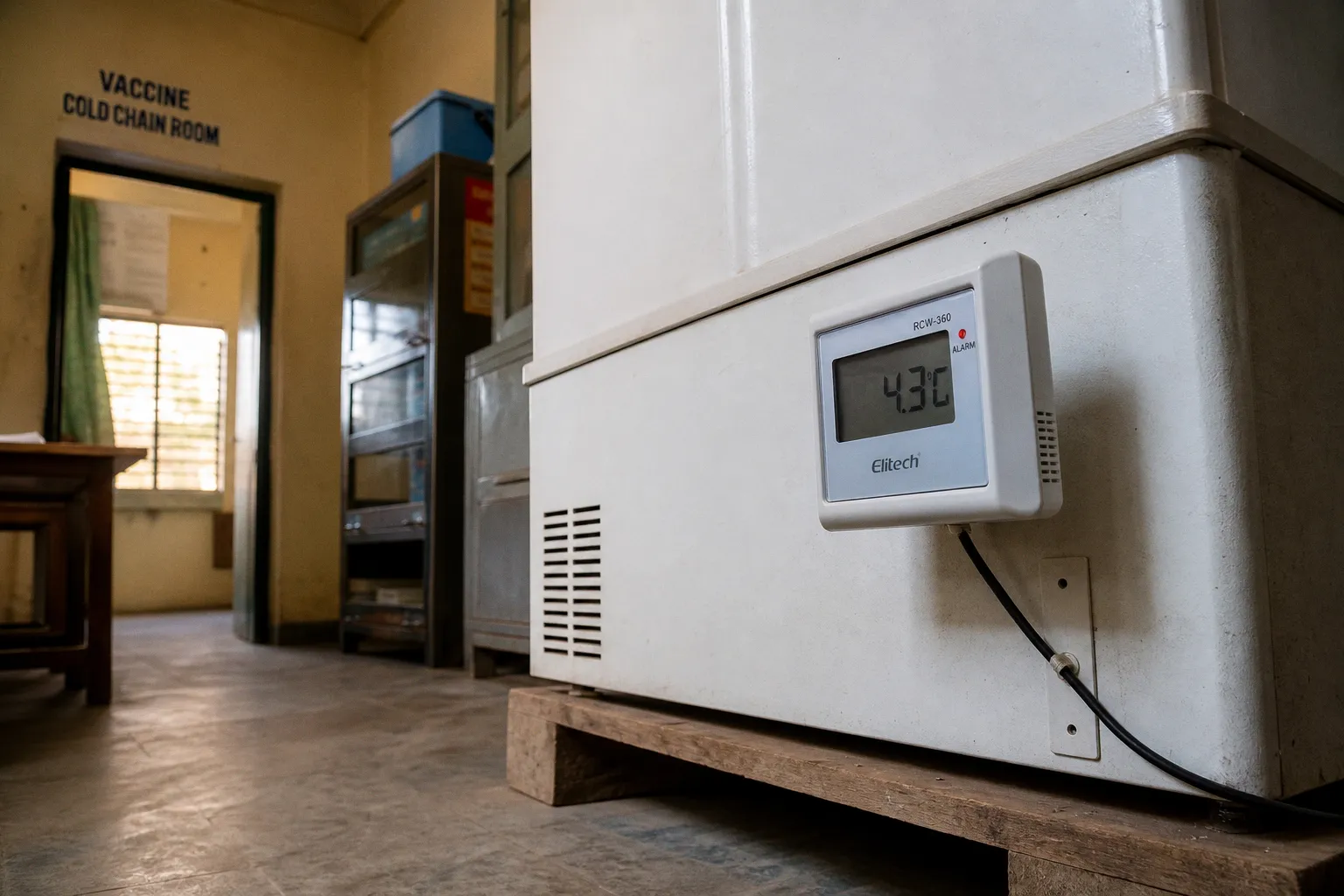
A rural PHC vaccine cold chain fails at its weakest control point. The relevant failure points are measurable: an ILR outside +2°C to +8°C, a deep freezer operating outside −15°C to −25°C, equipment placed against a wall, an unconditioned ice pack, or a freeze-sensitive vaccine stored in direct contact with ice.
The hardware is standardized. The operating environment is not. Power fluctuations, limited room space, irregular maintenance, high ambient temperatures, and variable staff availability convert a technically adequate facility into an unreliable storage node. A functional rural PHC vaccine cold chain setup therefore depends on layout, temperature control, stock arrangement, handling discipline, and digital oversight operating as one system.
The cold chain room is an engineering space
The cold chain room should not be treated as a general storeroom with an ILR installed wherever floor space remains. Equipment performance depends on ventilation, clearance, electrical protection, and access control.
At the PHC or sub-district level, the usual equipment configuration includes:
- An Ice-Lined Refrigerator (ILR) for vaccine storage at +2°C to +8°C.
- A Deep Freezer (DF) operating at −15°C to −25°C.
- Ice packs, commonly with a standard capacity of 0.4 litre, for vaccine carriers and session transport.
- Dedicated automatic voltage stabilizers for each electrical cold chain unit.
- Temperature monitoring devices and stock-management records, including digital monitoring where eVIN is deployed.
- Vaccine baskets and carriers arranged to prevent unnecessary handling and direct ice contact.
The deep freezer has a narrower function at PHC level than its name suggests. It is used for preparing ice packs. It must not be used to store vaccines or diluents. Treating the DF as a second vaccine refrigerator is not a flexible interpretation of the system. It is a storage error.
Equipment placement establishes the baseline for air circulation and service access. Each unit should be:
- Raised on a wooden block or pallet.
- Positioned at least 10 cm from the wall.
- Kept at least 20 cm from other equipment.
- Connected to its own automatic voltage stabilizer.
- Located where staff can inspect the unit, record readings, and remove stock without obstruction.
The clearance distances are operational controls, not cosmetic requirements. A refrigerator pressed against a wall has less opportunity to dissipate heat. A unit placed beside another heat-generating appliance creates a warmer local environment. Both conditions increase the burden on the compressor and complicate temperature recovery after door opening.
A cold chain room is not adequately equipped when the machines are present. It is adequately controlled when heat, power, airflow, and access are all managed.
The room should also be protected from avoidable temperature variation. Direct sunlight, rainwater exposure, dust accumulation, and repeated unsupervised access introduce variables that do not appear on the equipment inventory but affect reliability. The objective is not to create a sterile laboratory. It is to prevent the storage environment from becoming another source of temperature instability.
ILR and deep freezer operation are different processes
An ILR and a deep freezer perform different functions and should be managed according to different temperature limits.
| Parameter | Ice-Lined Refrigerator | Deep Freezer |
|---|---|---|
| Operating range | +2°C to +8°C | −15°C to −25°C |
| PHC-level function | Vaccine storage | Ice-pack preparation |
| Vaccine storage | Permitted within the prescribed range | Not permitted at PHC level |
| Diluents | Stored according to programme guidance and temperature requirements | Not stored |
| Main operational risk | Freezing or overheating vaccines | Inadequate freezing of ice packs or inappropriate storage use |
| Placement requirement | Pallet or wooden block; 10 cm from wall | Pallet or wooden block; 10 cm from wall |
| Electrical protection | Dedicated automatic voltage stabilizer | Dedicated automatic voltage stabilizer |
The ILR is designed to maintain a stable positive-temperature environment. Its ice lining supports temperature retention during short interruptions, but it does not remove the need for monitoring. The temperature range remains bounded. “Cold” is not a sufficient measurement category. A vial exposed to freezing conditions can be damaged even when the surrounding room appears cool.
The DF must reach and maintain the negative-temperature range required for ice-pack preparation. Its role is logistical. It produces the thermal resource required to transport vaccines safely to outreach sessions. It does not expand the permitted storage options for vaccines at the PHC.
Power protection is a separate control layer. Rural electrical supply may fluctuate even when an outage does not occur. Each item of electrical cold chain equipment should therefore be connected to its own dedicated automatic voltage stabilizer. One shared stabilizer for multiple units creates a common failure point and makes it more difficult to isolate an equipment fault.
Temperature monitoring must identify deviation, not merely record compliance
A temperature log has value only when it captures the operating pattern. A single reading taken during a routine visit cannot establish that the ILR remained within range during the preceding night, after a power fluctuation, or during periods of repeated door opening.
The monitoring process should allow staff to answer four questions:
1. What was the temperature at the time of inspection?
2. Did the unit remain within its required range across the monitoring interval?
3. Was there a power interruption or equipment event that could explain a deviation?
4. What action was taken when the range was breached?
The Electronic Vaccine Intelligence Network, or eVIN, digitizes vaccine stock and storage temperatures across India. Its function is broader than a digital thermometer. It links inventory visibility with temperature information and allows administrators to identify shortages and distribution problems across facilities. The supplied evidence associates eVIN with a vaccine availability rate above 99% and a reduction in stock-outs of more than 80%.
Those figures describe system-level performance associated with the platform. They do not mean that every rural PHC has identical connectivity, logger reliability, or response capacity. The exact failure rate of eVIN temperature loggers in remote tribal PHCs is not established in the available evidence. Digital oversight improves visibility. It does not substitute for local corrective action.
Vaccine arrangement inside the ILR determines exposure
An ILR should not be packed as tightly as possible. Vaccines must remain in baskets, with approximately 2 cm of space between boxes to permit air circulation. The arrangement should also separate products according to their sensitivity to freezing and heat.
The prescribed placement pattern is:
- Freeze-sensitive vaccines at the top, including DPT, TT, Hepatitis B, pentavalent, and IPV.
- Heat-sensitive vaccines at the bottom, including OPV, BCG, and measles vaccine.
- Vaccines kept in baskets rather than placed loosely across the floor or pressed against the internal walls.
- Space maintained between boxes so that cold air can circulate.
- Stock arranged to support first-expiry, first-out use and rapid visual inspection.
The distinction between freeze-sensitive and heat-sensitive vaccines is not interchangeable. Freeze-sensitive products can lose potency when exposed to freezing temperatures. Heat-sensitive products deteriorate when temperature control is inadequate in the opposite direction or when exposure continues for too long.
The common operational mistake is to interpret the coldest point in the ILR as the safest location for every vaccine. That is incorrect. Placement must reflect product sensitivity and the thermal behavior of the equipment. The top and bottom zones are not storage preferences. They are part of the handling protocol.
A well-arranged ILR also reduces door-open time. Staff should know where each vaccine category is located before opening the unit. Mixed cartons, unlabelled baskets, and overfilled shelves increase search time. Each additional minute of open-door operation is a small thermal disturbance; repeated across multiple sessions, it becomes a management pattern.
Stock arrangement is also an inventory-control measure
Cold chain management and stock management cannot be separated. A facility may maintain the correct temperature and still lose usable stock through expiry, poor rotation, or inaccurate records.
The physical layout should make the following visible:
- Which products are available for the next immunization session.
- Which lots have the earliest expiry dates.
- Which vials are reserved for outreach activity.
- Which stock has been returned and requires assessment before reuse.
- Whether recorded balances match the physical count.
This is where digital systems provide an administrative advantage. eVIN can make stock levels and temperatures available beyond the facility. The local arrangement must still be legible. A district dashboard cannot correct a basket system that staff cannot interpret during a busy session.
Ice packs are a controlled intermediate, not a disposable accessory
The deep freezer produces ice packs. The ice packs create the transport environment. The quality of that transition determines whether vaccines remain within their required thermal limits.
An ice pack must be conditioned before it is placed in a vaccine carrier. Conditioning means removing the frozen pack from the freezer and leaving it at room temperature until water droplets form and a sloshing sound can be heard when the pack is shaken.
The purpose is specific: to reduce the risk of freezing freeze-sensitive vaccines during transport or an immunization session. A fully frozen pack placed directly against a sensitive vial can generate a local temperature far below the permitted storage range, even when the carrier is otherwise packed correctly.
The sequence is operationally simple:
1. Remove the required ice packs from the deep freezer.
2. Leave them at room temperature for conditioning.
3. Confirm the appearance of water droplets.
4. Shake the pack and listen for the characteristic sloshing sound.
5. Place the conditioned packs in the vaccine carrier.
6. Arrange vials according to their freeze sensitivity.
7. Keep freeze-sensitive products away from direct ice-pack contact.
The timing of conditioning should be integrated into session preparation. It should not be improvised after the outreach team is already waiting. Delayed conditioning encourages shortcuts, and shortcuts create an avoidable risk of freezing.
The standard 0.4-litre pack capacity provides a reference for planning carrier preparation. The number of packs required depends on the carrier configuration, session duration, ambient conditions, and transport distance. It should not be inferred from the DF capacity. The commonly cited PHC-level DF capacity is 140 litres, but the freezer’s capacity describes its ability to prepare ice packs; it does not determine the number of vaccine vials that may be stored.
Immunization-session handling requires separation by thermal sensitivity
During an immunization session, vaccine vials are exposed to a different operating environment. The carrier is opened repeatedly. Stock is removed, used, returned, and sometimes held for later use according to programme rules. The arrangement must prevent the ice pack from becoming a direct source of freezing damage.
The session protocol distinguishes between two groups.
Non-freeze-sensitive vaccines that may be placed on a retrieved ice pack include:
- BCG.
- Measles vaccine.
- OPV.
- Rotavirus vaccine.
- Japanese encephalitis vaccine.
Freeze-sensitive vaccines that must not touch the ice pack include:
- IPV.
- TT.
- DPT.
- PCV.
- Pentavalent vaccine.
This distinction should be visible to every worker handling the carrier. It should not depend on one experienced vaccinator being present. Staff rotation and outreach deployment make institutionalized arrangement more reliable than individual memory.
A practical session carrier should therefore have a predictable internal pattern. Non-freeze-sensitive vials can be positioned in the zone supported by the retrieved ice pack. Freeze-sensitive products should be separated so that they remain cold without direct contact with the pack. Vials should not be placed randomly on top of one another, where contact conditions change each time the carrier is opened.
The main handling errors are predictable
Most session-level failures are not obscure technical events. They are deviations from a short sequence of known controls:
1. Using an unconditioned ice pack.
The pack remains too cold and can freeze sensitive vaccines on contact.
2. Placing all vaccines on the ice pack.
Thermal sensitivity is ignored for the sake of convenience.
3. Opening the carrier repeatedly without a retrieval plan.
The internal environment becomes less stable and the team loses track of stock.
4. Returning vials without a clear disposition.
Used, unused, opened, and returned stock can become mixed.
5. Treating the carrier as a temporary storeroom.
Transport equipment is used beyond its intended control conditions without documentation.
These errors are operational, not theoretical. They are also measurable through supervisory observation, stock reconciliation, and temperature records. A district review should examine the process rather than simply record whether a vaccine carrier was present.
The cold chain is preserved by controlled transitions: freezer to conditioned pack, ILR to carrier, carrier to session, and session back to documented stock disposition.
Building a rural PHC cold chain equipment list that reflects function
An equipment list should map each item to a risk it controls. Counting appliances without examining their use produces a false sense of readiness.
| Equipment or control | Function | Failure consequence |
|---|---|---|
| ILR | Maintains vaccine storage at +2°C to +8°C | Freezing, overheating, or potency loss |
| Deep freezer | Prepares ice packs at −15°C to −25°C | Inadequate transport preparation |
| 0.4-litre ice packs | Provide controlled cold support during transport and sessions | Unstable carrier temperature or freezing exposure |
| Wooden blocks or pallets | Raise equipment and improve clearance | Poor airflow, moisture exposure, restricted cleaning |
| Dedicated voltage stabilizer | Protects each unit from power fluctuation | Electrical damage or compressor failure |
| Vaccine baskets | Maintain organized storage and airflow | Obstructed circulation and slow stock retrieval |
| Temperature monitoring system | Detects excursions and supports response | Undetected exposure and weak accountability |
| eVIN connectivity and records | Links stock and temperature visibility | Delayed replenishment and limited district oversight |
The common ILR capacities cited for smaller facilities are approximately 90 to 105 litres. Capacity should be assessed against the facility’s actual vaccination workload, not against an abstract maximum. A unit can be technically functional but operationally inadequate if stock is compressed into a layout that blocks airflow or makes expiry rotation impossible.
Capacity planning should examine:
- Routine vaccine volume.
- Outreach session frequency.
- Seasonal demand.
- Delivery intervals.
- Buffer stock requirements.
- Number and size of vaccine baskets.
- Available space for safe retrieval and cleaning.
A facility that consistently fills its ILR to the point of obstructing circulation has an inventory-management problem, even if the compressor remains operational. Conversely, a large empty unit does not demonstrate readiness if temperature records are absent or the stabilizer is defective.
A supervisory review should follow the chain of evidence
A district-level assessment should not stop at equipment presence. It should trace whether the controls function together.
A useful review sequence is:
1. Inspect the room.
Confirm the 10 cm wall clearance, 20 cm separation between equipment, raised placement, ventilation, and protection from avoidable environmental exposure.
2. Verify electrical protection.
Establish that each cold chain appliance has its own automatic voltage stabilizer and that the connection is functional.
3. Read the equipment temperatures.
Confirm ILR operation within +2°C to +8°C and DF operation within −15°C to −25°C.
4. Inspect vaccine placement.
Check baskets, 2 cm spacing between boxes, and separation of freeze-sensitive and heat-sensitive products.
5. Confirm the DF’s designated use.
Vaccines and diluents should not be stored in the PHC deep freezer.
6. Observe ice-pack conditioning.
The process should include room-temperature conditioning, visible droplets, and the sloshing test.
7. Inspect session carriers.
Verify that non-freeze-sensitive vaccines and freeze-sensitive vaccines are positioned according to their handling requirements.
8. Reconcile stock.
Compare physical vials with records and identify expiry, return, or wastage anomalies.
9. Review digital monitoring.
Where eVIN is deployed, compare facility-level records with reported temperature and stock information.
10. Document corrective action.
A deviation without an assigned response, responsible person, and follow-up date is only an observation.
This sequence moves from infrastructure to behavior and then to data. That order matters. A temperature excursion cannot be interpreted without knowing whether the equipment was correctly placed, electrically protected, and maintained. A stock-out cannot be interpreted without examining inventory records, replenishment timing, and the facility’s actual storage capacity.
The policy implication is straightforward
India’s rural vaccine cold chain is not constrained only by the number of ILRs and deep freezers installed. Its performance depends on whether each PHC preserves the technical distinction between storage, freezing, transport, and session handling.
The core standards are precise:
- +2°C to +8°C for the ILR.
- −15°C to −25°C for the deep freezer.
- 10 cm from the wall.
- 20 cm between equipment.
- 2 cm between vaccine boxes.
- Condition ice packs before use.
- Keep freeze-sensitive vaccines away from direct ice-pack contact.
- Use the deep freezer for ice-pack preparation, not vaccine storage.
- Protect every electrical unit with a dedicated automatic voltage stabilizer.
- Use eVIN and local records to connect temperature control with stock visibility.
These requirements are not expensive abstractions. They are control variables that can be audited at facility level. Their value lies in consistency. A district with modern monitoring but poor physical arrangement will retain blind spots. A PHC with adequate equipment but weak handling discipline will retain exposure risk. A facility with correct procedures but no response to deviations will generate records without control.
The relevant measure of readiness is therefore not equipment count. It is the proportion of cold chain steps that remain within specification from receipt to administration. At district scale, that proportion determines whether reported vaccine availability translates into usable, potent vaccine at the point of care.