Paper registers versus mobile apps for ASHA data
In a busy village clinic, the most revealing question is not whether an ASHA worker owns a smartphone.
It is whether she can finish documenting a home visit before the next woman arrives with a missed period, a newborn with feeding trouble, or a child due for immunisation.
Compare car rental deals in United Kingdom
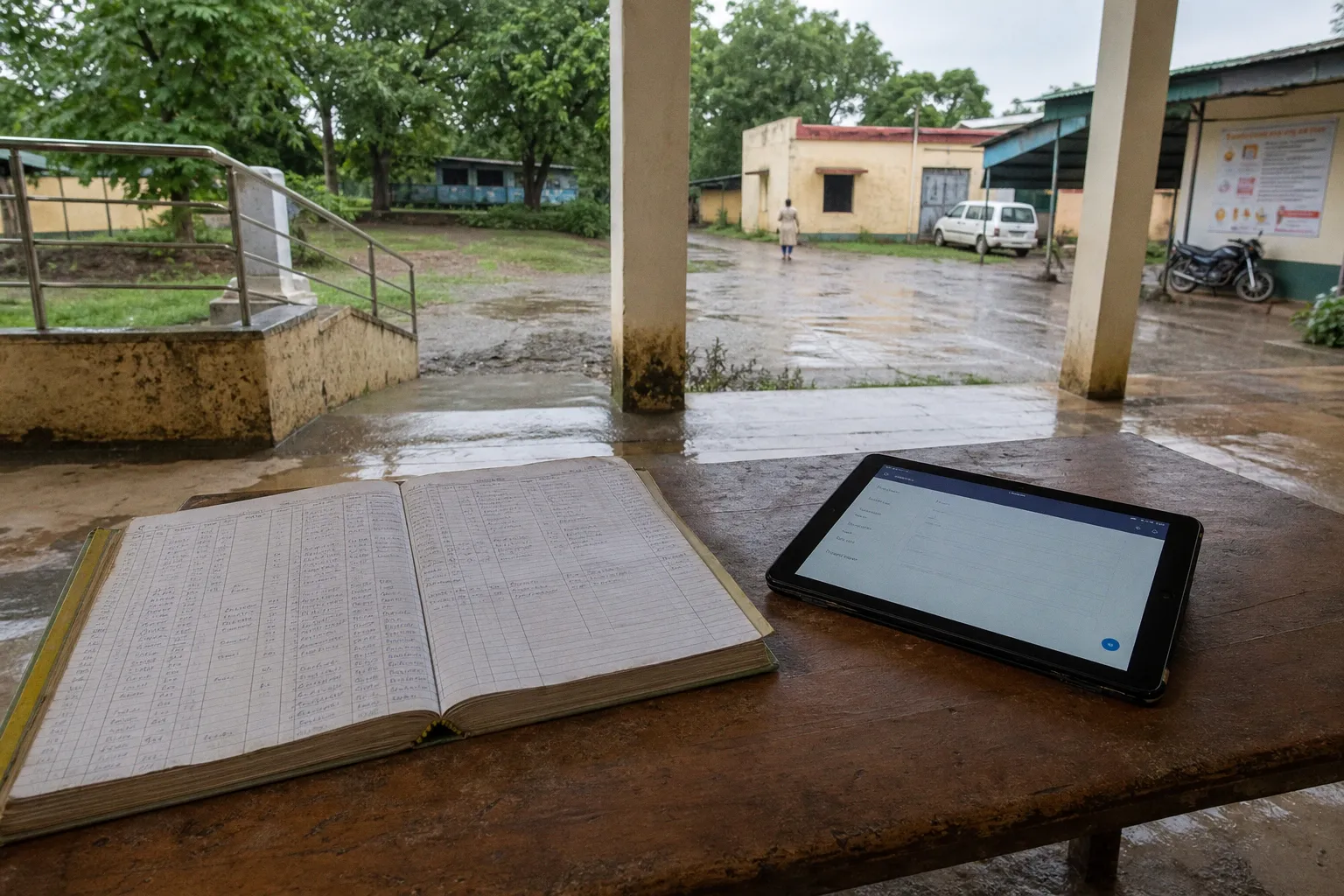
See available offersPartner link — DiscoverCars comparisonFor many Accredited Social Health Activists, the answer is no—not because they are resistant to digital care, but because the promised replacement has become an addition. They may still carry 10 or 11 paper registers for family planning, reproductive and child health, tuberculosis, non-communicable diseases, and other programmes, then enter much of the same information into several mobile applications. This is the central problem in the debate around ASHA data collection: paper versus mobile apps. India has not simply moved from paper to digital. In many districts, it has asked frontline workers to live in both systems at once.
I have seen how easily this becomes invisible from a district office. A completed digital dashboard can look like progress. But at the household level, every data point begins with a conversation: a woman deciding whether to disclose a pregnancy early, a mother explaining why she missed an antenatal visit, an older person trying to remember their diabetes medication. The ASHA’s time is not an administrative spare part. It is part of care.
A digital record is only useful if it gives the frontline worker more time for people, rather than more screens to complete after people have gone home.
The double burden: when an app sits beside the register
Paper registers are cumbersome, certainly. They take space, need careful handwriting, and turn monthly reporting into a laborious process of counting, cross-checking, and copying. In the traditional arrangement, an ASHA may spend up to a week each month tabulating reports with as many as 300 columns before passing them to data-entry operators at the primary health centre.
Mobile tools were introduced to ease precisely this burden. In principle, a community health worker digital tool can prompt follow-ups, record services at the point of care, flag high-risk pregnancies, support counselling, and make information available to the primary health centre sooner. Tools such as mSakhi have shown that several separate materials—flipbooks, manuals, and registers—can be brought into one workflow for maternal, newborn, child health, and non-communicable disease follow-up.
That is the promise. The reality on the ground is often a duplicate workflow.
An ASHA may write details in the register during or after a visit because the family needs a clear response, the phone battery is low, the signal is absent, or the application is slow. Later, she enters the same details digitally. She may also be asked for programme-specific reports that have not yet been fully absorbed into the app’s reporting structure. The paper record remains necessary for verification; the mobile entry remains necessary for the portal. Neither system is allowed to become the single source of truth.
This is why it is misleading to frame the issue as a simple contest between old paper and modern technology. The real comparison is between a stable but heavy documentation method and a digital layer that may or may not reduce the total work attached to it.
| Practical question | Paper registers | Mobile apps in a well-supported workflow | What often happens in rural districts |
|---|---|---|---|
| Recording a household visit | Can be completed without power or signal | Can be entered during the visit and used for prompts | Paper is used first; app entry is postponed and duplicated |
| Data availability at PHC level | Delayed until reports are compiled | Potentially near real-time | Uploads depend on network, app function, and worker support |
| Clinical continuity | Familiar and locally accessible | Can surface due dates, referrals, and missed follow-ups | Information may be split across registers, apps, and portals |
| Worker time | High monthly reporting burden | Should reduce repeated aggregation | Workload can increase when paper requirements remain |
| Cost to the ASHA | Stationery and time costs | Phone, charging, data, repairs, and time | Workers may personally carry some digital costs |
| Reliability during outages | Strong | Dependent on offline design and later syncing | Failed synchronisation can create fear of data loss |
The distinction matters for primary health centre management. If a PHC sees only that mobile registrations are rising, it may assume digitisation is working. A more honest measure asks: have paper fields actually been retired? Has the number of separate portals fallen? Has an ASHA’s evening reporting time reduced? Can she retrieve a woman’s care history during a home visit without calling someone for help?
Without those answers, “digitisation” can become a word for shifting clerical work downward.
Digital literacy is not a personal failing
There is a habit, especially in policy discussions, of treating digital difficulty as an individual weakness: a worker is said to be “not tech-savvy,” as though that explains everything. It does not. Digital confidence is shaped by education, language, device access, interfaces, training quality, household responsibilities, and the availability of help when something goes wrong.
A 2025 government survey found that 64% of rural women in India could not perform basic smartphone tasks. This figure should make anyone designing frontline digital systems pause. ASHAs are skilled community health workers, not professional data operators or software testers. Many have learned complex health messages, built trust across caste and household boundaries, accompanied women through antenatal care, supported immunisation, and identified danger signs in newborns. These are substantial competencies. They do not automatically translate into navigating passwords, app updates, error messages, multiple log-ins, or a screen that freezes halfway through a form.
In Haryana, reports indicated that only around 3,000 of more than 20,000 ASHA workers—primarily those with a high school education—could complete all digital tasks independently. Many depended on family members for assistance with smartphone entries. That is not a small operational inconvenience. It raises serious questions about confidentiality, autonomy, and data quality.
When an ASHA has to ask a son, husband, neighbour, or local shopkeeper to help submit reproductive-health information, the care pathway is no longer private in the way it should be. Even if no one intends harm, a woman’s pregnancy status, contraceptive choice, tuberculosis treatment, or chronic illness can become visible to people who are not part of her care team.
The training gap is usually a support gap
A one-day orientation is not the same as training. And training is not the same as ongoing support.
In my experience, people learn digital clinical tools best when they can practise with realistic cases, make mistakes without being shamed, and receive immediate help in the language they use every day. A laminated instruction sheet is not enough when an application has changed its menu, an ID does not match, or an offline record will not synchronise.
A workable support structure has several layers:
1. Hands-on practice before mandatory reporting begins. ASHAs should work through common scenarios: registering a pregnancy, documenting a home-based newborn care visit, correcting an error, finding a missed follow-up, and using the app without network access.
2. Named local technical support. A worker should know exactly whom to contact at the PHC or block level, and that person must have the authority and time to resolve problems rather than simply redirect them.
3. Training in small groups and local languages. A large demonstration in a meeting hall often leaves quieter workers behind. Small-group repetition is slower at first and much faster in the long run.
4. A safe correction process. If workers fear that an incorrect digital entry will affect incentives or attract blame, they will understandably rely on paper notes and delay submission. The system needs a visible route for correcting records.
5. Respect for the worker’s existing method. Digital adoption succeeds when trainers begin with the register the ASHA already knows and show exactly how fields map across, rather than speaking as though years of field documentation have no value.
The question is not whether ASHAs can learn. They can, and many do, remarkably well. The question is whether the health system is willing to teach, maintain, and simplify the technology with the same seriousness it expects workers to bring to reporting.
The hidden price of the smartphone revolution
Digital health is frequently described as efficient, but efficiency for the system can conceal costs for the person holding the device.
Many ASHAs use their own smartphones and pay for mobile data to meet reporting requirements. They also bear the practical costs of charging a phone in areas with unreliable electricity, replacing a damaged screen, managing storage space, and keeping a device safe while travelling from household to household. A phone used for health reporting is not simply a phone. It is a work instrument, often purchased or maintained in conditions where every household expense has to be weighed carefully.
The time cost is just as real. Some ASHA workers have reported spending around 50 hours each month recording services across 10 registers and five mobile apps. At a national scale, estimates have suggested that ASHAs collectively spend 50 million hours each month feeding data into 50 portals. Even allowing for variation between states and programmes, the direction is clear: fragmentation consumes care time.
This matters most in the very places where primary health care is already stretched. The ASHA is expected to mobilise women for antenatal check-ups, encourage institutional births, track newborns and immunisation, follow family planning needs, support screening and treatment adherence, and connect households to the PHC. If reporting expands endlessly, the work that is hardest to measure—listening, counselling, returning for a second visit—gets squeezed.
The cost of a digital system should be counted in rupees, hours, battery life, and the missed conversations that never appear in a dashboard.
For district managers, the practical test is straightforward: if a reporting requirement needs a smartphone, data connection, and repeated use of an app, those inputs must be treated as routine programme costs. They should not be quietly transferred to a frontline worker because she happens to own a handset.
Bihar showed what a data gap can mean
In December 2024, officials in Bihar discovered that health data for nearly 20 million people had not been uploaded. The number is startling, but it should not invite an easy conclusion that workers simply failed to comply. ASHA workers pointed to inadequate training and technical support. That explanation deserves to be taken seriously.
A missing upload is not always a missing service. A woman may have been counselled. A child may have been visited. A referral may have been made. But if the digital record cannot be entered, saved, or synced, the health system loses sight of that care. From the district level, it can look as though nothing happened. From the ASHA’s side, it can feel as though hours of work have vanished because the technology did not hold.
There are several ways this failure harms the care pathway:
- Follow-up lists become unreliable. If pregnancy registration or immunisation records are incomplete, workers and facilities may not see who is due, overdue, or at heightened risk.
- Supplies can be planned against the wrong denominator. Incomplete beneficiary data distorts local estimates for medicines, testing supplies, contraceptives, and outreach sessions.
- Incentive-related records become vulnerable to dispute. When service delivery and digital confirmation do not align, workers may spend additional time proving work that should already be visible.
- PHC teams lose confidence in their own data. Staff then return to parallel lists, phone calls, and paper tallies, which recreates the very duplication digitisation was meant to remove.
- Communities bear the consequence quietly. A woman whose record is missing may not know why her follow-up did not happen. She only experiences another gap in care.
The lesson from Bihar is not that mobile health records should be abandoned. It is that a digital system must be judged by what happens when connectivity is weak, support is absent, and thousands of records need to move at once. A platform that works only in ideal conditions is not yet health infrastructure.
ANMOL, paper registers, and the problem of too many systems
When people search for “ANMOL app versus paper registers,” they are usually asking a practical question: will the app genuinely make reporting simpler for the worker and more useful for the patient?
The answer depends less on the name of any individual platform than on how it is integrated into daily care. ANMOL and other maternal and child health digital systems can help standardise records, make beneficiary tracking more visible, and support continuity between community work and facility services. But no application can solve a workflow that remains fragmented across multiple registers, multiple portals, and multiple reporting chains.
For an ASHA, the ideal system would not require her to remember which service belongs in which app. It would allow a single household interaction to update the relevant care record once, with the information available to the appropriate team members. It would work offline, make its sync status obvious, and preserve data safely until connection returns. It would also avoid asking the worker to repeat information that has already been captured by an ANM, PHC nurse, or data-entry operator.
This is where PHC health-record digitisation needs more clinical thinking and less software enthusiasm. The record is not an end in itself. It exists to support a sequence of human actions:
- identify a person who needs care;
- document what has happened without taking excessive time;
- alert the right worker to the next action;
- make referral information available when needed;
- protect confidentiality;
- and make the record dependable enough that staff do not rebuild it on paper.
If any one of these steps fails, frontline teams create workarounds. Workarounds are often sensible responses to a system that does not fit the reality of rural healthcare delivery. But they also make the official data less complete and the worker’s load heavier.
What an integrated platform should actually do
The phrase “integrated platform” can sound abstract, so I prefer to make it concrete. For ASHAs and PHC teams, integration should mean fewer repeated entries and clearer responsibility—not one more dashboard.
A platform worthy of frontline adoption should provide the following:
One record, entered once
The same maternal or child-health information should not have to be copied into separate programme tools unless there is a clinical reason to collect it differently. If family planning, antenatal care, immunisation, and NCD follow-up all require overlapping demographic details, the system should carry those details forward securely.
Offline-first functioning
Rural connectivity is not a rare exception; it is a normal operating condition in many districts. The application must allow data capture without a live signal, clearly show what is saved locally, and synchronise reliably when connection returns. Workers need assurance that an entry has not disappeared simply because a network bar vanished.
A role-sensitive view of the patient journey
An ASHA, ANM, staff nurse, medical officer, and data-entry operator do not need the same screen. They do need compatible information. The ASHA may need a simple due-list and counselling prompts; the PHC nurse may need immunisation status and risk flags; the medical officer may need referral patterns and supply implications. Good design respects these different roles while keeping the underlying record coherent.
A transition plan for retiring paper
Paper cannot be removed overnight where connectivity, audit rules, or staff confidence are not ready. But keeping it forever “just in case” turns transition into permanent duplication. Districts need explicit decisions about which register fields remain mandatory, which are being phased out, and what evidence is acceptable when the app has failed.
Feedback that reaches the worker
ASHA workers contribute enormous amounts of information, yet they are often the last to see how it is used. A useful system returns something practical: a list of children who missed a visit, a reminder for a high-risk pregnancy follow-up, confirmation that a referral was completed, or a notice that data have successfully synced. Data should travel back to the worker as support, not only upward as reporting.
A better route forward begins with listening
The transition from paper registers to mobile apps is often presented as inevitable. In broad terms, it probably is: timely, usable digital records can strengthen maternal and child health services, especially when PHCs need to coordinate care across dispersed villages. But inevitable does not mean automatically beneficial.
The right question is not, “How quickly can every ASHA be moved onto an app?” It is, “Does this tool make her daily care work safer, more private, and more manageable?”
For practitioners and district teams, I would begin with a simple field exercise. Sit with ASHAs during a normal reporting week. Count every register, app, portal, login, and repeated field. Watch what happens when the signal drops. Ask who pays for data. Ask which records they trust when a woman’s history is unclear. Then remove one duplicate step before adding a new digital requirement.
That is how digital health becomes credible: not through a declaration that paper is outdated, but through systems that respect the worker who must carry the record from one household to the next.