PHC Equipment Downtime: How to Prevent Costly Delays
Before the national Biomedical Equipment Management and Maintenance Program (BMMP), between 13% and 34% of medical equipment in India’s public health facilities was dysfunctional.
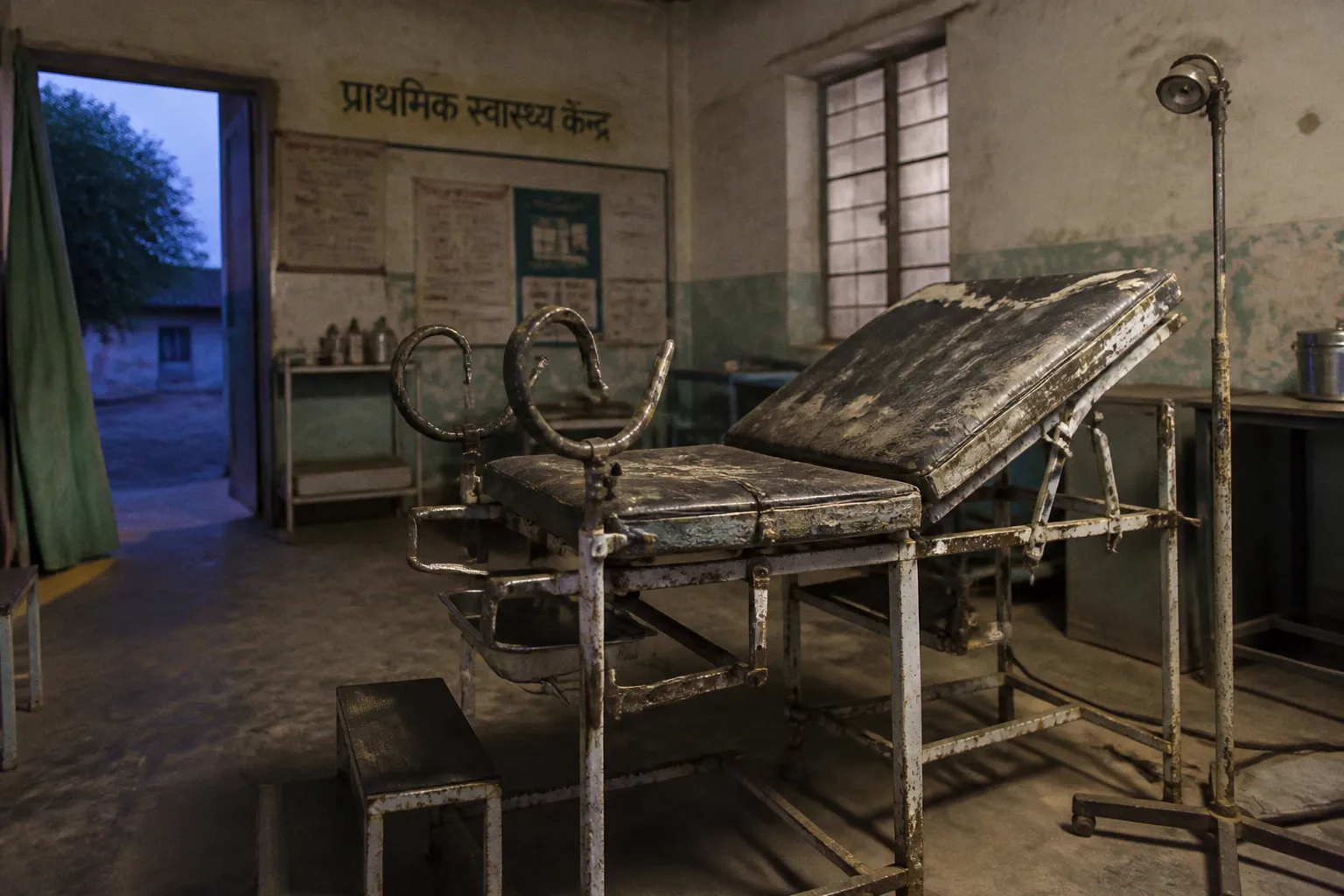
The mapped inventory covered 7,56,750 devices across 29,115 facilities, with an estimated equipment value of approximately ₹4,564 crore. The estimated financial loss associated with dysfunctional equipment was ₹1,015.74 crore.
These figures define the problem more accurately than the usual language of “limited resources.” Rural PHC equipment maintenance delays are not a single funding failure. They are a compound infrastructure failure involving procurement, asset registration, technician availability, spare-parts logistics, service contracts, geography, and operational handling.
At a Primary Health Centre, a non-functional ECG machine is not merely an engineering defect. It removes a diagnostic capability from the local care pathway. The patient may then be referred to a Community Health Centre or district hospital. That referral consumes transport capacity, staff time, and clinical attention. If the failed device is an X-ray unit, laboratory analyser, autoclave, or oxygen-related system, the effect can extend across several services at once.
The operational question is therefore narrow and measurable: how can a health system reduce the duration, frequency, and clinical effect of equipment downtime at rural PHCs?
Downtime is a systems variable, not an isolated repair event
Equipment failure is usually recorded as a technical incident. Health-system performance depends on a broader set of variables:
- whether the equipment is included in a current inventory;
- whether its location and functional status are visible to district managers;
- whether the maintenance contract defines a response time and a repair time;
- whether qualified technicians can reach the facility;
- whether replacement parts are available;
- whether the device has been used according to manufacturer instructions;
- whether the PHC can operate the equipment safely while waiting for repair;
- whether the failure affects a core service or a redundant one.
A facility survey that records only the number of working machines will miss the principal operational distinction between a device that fails once for two days and a device that remains unusable for six months. Both may appear as “non-functional” in a static dataset. Their consequences are not equivalent.
For district health managers, the relevant indicators should separate at least four dimensions:
1. Availability: the proportion of installed equipment that is operational at a given time.
2. Reliability: the frequency of repeat failures within a defined period.
3. Maintainability: the time and resources required to restore service.
4. Clinical substitutability: the extent to which another facility or device can provide the same function.
The Mean Time to Repair, or MTTR, is useful because it measures restoration speed rather than procurement volume. Digital equipment-management systems such as e-Upkaran reduced MTTR for critical primary diagnostic equipment. ECG machine MTTR declined by 2.6 times, while X-ray machine MTTR declined by 2.5 times in the reported evaluation.
That result has a direct management implication. A district does not necessarily need to purchase more equipment before it has established whether existing assets are visible, serviceable, and supported.
The first infrastructure question is not how many devices a PHC owns. It is how many can produce a valid clinical result today.
BMMP creates a measurable performance floor
The national BMMP guidelines establish different uptime standards by facility tier:
| Facility tier | BMMP uptime standard | Operational meaning |
|---|---|---|
| Primary Health Centre | 80% | The facility should maintain equipment availability sufficient for routine primary-level services, with defined repair escalation for failures. |
| Community Health Centre | 90% | Higher availability is required because CHCs carry broader diagnostic and treatment functions. |
| District Hospital | 95% | The highest benchmark reflects greater service concentration and the wider consequences of equipment failure. |
The standards are not interchangeable. Applying a district-hospital benchmark to every rural PHC would ignore differences in case mix, technical complexity, staffing, and referral design. Treating the PHC benchmark as a ceiling rather than a minimum performance requirement would create the opposite error.
An 80% uptime standard also does not mean that 20% downtime is clinically acceptable for every device. A facility-wide aggregate can conceal a critical failure. If a low-use device is available most of the year while the only ECG machine is repeatedly out of service, the aggregate uptime figure may appear compliant while cardiac assessment capacity is impaired.
The denominator must therefore be defined. A district dashboard should distinguish:
- facility-level uptime;
- device-level uptime;
- service-level uptime;
- downtime for critical versus non-critical equipment;
- scheduled maintenance downtime;
- unscheduled failure downtime;
- waiting time for diagnosis;
- waiting time for spare parts;
- waiting time for technician travel;
- time from repair completion to verification and return to service.
This is the difference between an administrative inventory and a management instrument. The former describes assets. The latter describes the capacity of the health system to deliver care.
The first prevention measure is accurate asset mapping
The national inventory mapping exercise identified more than seven hundred thousand pieces of equipment across public facilities. A dataset of that scale is useful only if the records remain operationally current.
Each PHC asset should have a traceable record containing:
- equipment category and model;
- manufacturer and supplier;
- serial number;
- installation date;
- warranty status;
- maintenance-contract status;
- last preventive-maintenance date;
- current functional status;
- assigned facility and service unit;
- recurring fault history;
- required consumables and spare parts;
- responsible service provider;
- escalation route for unresolved failures.
The record should also identify whether the equipment is clinically critical. A functioning backup printer and a functioning defibrillator do not have equivalent value to the facility. A district that ranks every device only by purchase price will misallocate attention.
Asset mapping should be reconciled against physical inspection. Procurement records alone are insufficient. Equipment may be transferred between facilities, stored without installation, cannibalised for parts, or retained after the service for which it was purchased has changed. A database that reports an asset as present does not establish that it is accessible, calibrated, staffed, or connected to a usable supply chain.
A practical classification can divide equipment into three groups:
- Critical diagnostic and treatment equipment: failure directly limits a core clinical service or creates immediate referral pressure.
- Service-support equipment: failure reduces efficiency but does not necessarily halt patient care.
- Low-criticality or redundant equipment: failure can be absorbed through substitution, scheduling, or referral.
This classification should be reviewed at district level. A machine that is redundant in a district hospital may be the only available unit in a remote PHC. Criticality is a function of the local service network, not merely the technical specification.
Why rural PHC maintenance delays persist
The maintenance constraints identified in rural and tribal districts are structural. Four recurrent bottlenecks dominate.
Geographic access
A technician based in a district headquarters may need to travel long distances to reach a PHC. Travel time increases when roads are poor, transport is unavailable, or several facilities require service in the same visit. The contractual response time may be formally defined, but the practical repair time depends on the geography of the service area.
This creates a distinction between response time and restoration time. A service provider may acknowledge a complaint promptly while the equipment remains unavailable because the technician, diagnostic tools, or replacement part has not arrived.
District contracts should therefore measure the complete pathway:
1. fault reported;
2. fault acknowledged;
3. remote diagnosis attempted;
4. technician assigned;
5. site visit completed;
6. spare part identified;
7. repair performed;
8. safety and functionality verified;
9. equipment returned to clinical use.
Each stage produces a different delay. Combining them into one vague service metric prevents targeted correction.
Shortage of biomedical technicians
Rural facilities often lack local biomedical engineering capacity. This forces dependence on external vendors or district-level technical teams. The consequence is not merely a shortage of labour. It is a loss of diagnostic speed.
A trained local technician can identify whether a fault concerns power supply, calibration, software, consumables, operator error, or a failed component. Without that first-level assessment, every incident may be escalated as a full technical breakdown. The system then spends time transporting people or parts before establishing what has failed.
The solution is not to place a highly specialised engineer at every PHC. That would be inefficient for many districts. A tiered model is more plausible:
- basic operator training at the PHC;
- first-line troubleshooting by a trained district or block technician;
- regional specialist support for complex equipment;
- manufacturer or authorised service-provider escalation for proprietary faults.
The model requires written boundaries. Staff should know which interventions are permitted and which would void a warranty or create a patient-safety risk.
Spare-parts non-availability
A repair cannot be completed by technical skill alone. If a replacement board, sensor, battery, tube, filter, or calibration component is unavailable, the equipment remains down.
Spare-parts logistics should be managed as a separate supply-chain function rather than treated as a minor component of equipment procurement. The purchase decision should record:
- expected service life;
- consumable requirements;
- availability of authorised parts;
- local or regional service coverage;
- estimated lead time for common failures;
- compatibility of parts across the installed fleet;
- end-of-support conditions;
- total cost of ownership.
FICCI and DUA Consulting industry data identify spare-parts shortages, improper maintenance, product failure, and operational mishandling as factors accounting for nearly half of equipment downtime causes. The implication is straightforward: a low acquisition price can be misleading if the device has a high maintenance burden or an unreliable parts pipeline.
Lack of local support services
Some facilities are technically covered by a contract but practically unsupported. The provider may have no local service centre, no reserve stock, or no incentive to maintain a dispersed rural fleet. A contract that specifies only annual preventive maintenance can perform poorly when the dominant risk is unscheduled failure.
Service-level agreements should define:
- maximum acknowledgement time;
- maximum diagnostic time;
- maximum restoration time;
- replacement-equipment provisions for prolonged failures;
- escalation procedures;
- penalties or corrective actions for repeated breaches;
- documentation requirements;
- training obligations;
- verification of repair quality.
The contract should also distinguish equipment categories. A single response standard for an autoclave, ECG machine, ultrasound system, and laboratory refrigerator is administratively simple but operationally weak.
Preventive maintenance must be linked to clinical use
Preventive maintenance is often reduced to a scheduled visit and a signed form. That is inadequate. The maintenance schedule should reflect equipment type, usage intensity, environmental conditions, and failure history.
A PHC in a hot, dusty, humid, or unstable-power environment may expose equipment to stresses that are not visible in the procurement file. Power fluctuations, inadequate earthing, poor ventilation, and irregular cleaning can shorten service life. These conditions are not corrected by purchasing a more expensive machine unless the facility environment is also addressed.
Preventive maintenance should include functional verification, not only visual inspection. For diagnostic devices, the question is whether the machine produces a clinically reliable output. For sterilisation equipment, the question is whether the required sterilisation parameters are achieved. For cold-chain or laboratory equipment, the question is whether temperature or analytical performance remains within the relevant operating range.
The maintenance record should capture recurring faults. A device that is repeatedly repaired for the same problem may be consuming funds without restoring dependable service. At that point, the district must compare the expected remaining service life and repair cost against replacement or fleet standardisation.
A simple replacement decision can be framed around five variables:
- cumulative repair cost;
- frequency of failure;
- clinical criticality;
- availability of compatible spare parts;
- expected service life of the replacement.
This is not a call for routine replacement. It is a method for identifying assets that have become operational liabilities.
Digital tracking changes the management problem
Paper-based reporting creates latency. A failure may be known at the PHC but remain invisible to district administrators until a monthly review or a physical inspection. Digital tracking compresses that delay and creates an auditable history.
The value of systems such as e-Upkaran is not limited to electronic recordkeeping. Their management function lies in the ability to expose patterns:
- which facilities have the highest unresolved-failure burden;
- which equipment models fail repeatedly;
- which vendors miss restoration targets;
- which spare parts generate the longest delays;
- whether preventive maintenance is completed on time;
- whether repairs are followed by repeat failure;
- whether downtime is concentrated in particular geographic clusters.
The dashboard should not reward superficial closure. A ticket marked “resolved” is not equivalent to a device verified as functional under clinical use. Closure should require evidence of repair, testing, and handover to the responsible facility.
A district-level dashboard can use a compact operational table:
| Indicator | Why it matters | Management response |
|---|---|---|
| Current equipment availability | Shows the present service capacity of the PHC | Escalate critical failures immediately |
| Median MTTR by equipment type | Identifies slow repair pathways | Review technician coverage and parts stock |
| Repeat failure rate | Detects unreliable assets or poor repairs | Investigate model, vendor, or operating conditions |
| Preventive-maintenance completion | Measures whether planned work is occurring | Correct missed visits and weak documentation |
| Parts-related downtime | Isolates supply-chain failure | Establish regional stock or approved alternatives |
| Critical-service downtime | Links technical failure to clinical effect | Provide temporary substitution or referral support |
The most useful comparison is often not between districts with high and low downtime. It is between districts with similar geography, fleet size, and facility tier but different MTTR and repeat-failure profiles. That comparison can reveal management practices that an aggregate national average cannot.
Procurement decisions determine future downtime
Equipment procurement is frequently evaluated at the point of purchase. Downtime is determined over the full life cycle.
A procurement specification should therefore include technical support and maintenance terms from the beginning. The relevant assessment is not simply whether the device performs its stated function on installation day. It is whether the district can keep it operational over several years in the conditions where it will be used.
The total-cost-of-ownership framework should include:
- acquisition and installation;
- training;
- calibration;
- consumables;
- preventive maintenance;
- corrective maintenance;
- spare parts;
- software or licence support where applicable;
- transport and technician travel;
- equipment disposal or replacement.
Standardising models within a district can reduce training complexity and simplify spare-parts management. Excessive model variation produces a fragmented fleet. Staff must learn different interfaces, technicians must carry different parts, and procurement teams must manage multiple service arrangements.
Standardisation has limits. A district should not select a device solely because it matches an existing fleet if the technology is unsuitable for the local clinical workload. The correct objective is controlled variation: enough uniformity to simplify support, with enough flexibility to match clinical requirements.
The same logic applies to digital records. An equipment-management system should connect, where feasible, with facility reporting and maintenance workflows. It should not become another isolated database that requires duplicate entry and generates no operational decision.
Building a district response model
A workable district model begins with classification rather than universal intervention. Not every facility requires the same technical arrangement.
For each PHC, district managers can map:
- the equipment required for its designated service package;
- the nearest facility with equivalent or substitutable capacity;
- the travel time for technical support;
- the availability of trained operators;
- the local power and environmental risks;
- the vendor coverage area;
- the stock position for common spare parts;
- the clinical consequence of prolonged failure.
This map identifies where a small equipment failure becomes a network failure. A PHC without a functional diagnostic device may be able to refer patients if the receiving CHC has capacity. If several PHCs depend on the same overloaded CHC, however, the referral system becomes a bottleneck.
District hospital capacity must therefore be analysed alongside PHC downtime. Measuring rural medical facility downtime without measuring referral absorption produces an incomplete picture. A functioning district hospital cannot automatically compensate for widespread primary-level equipment failure. Its laboratories, imaging services, outpatient departments, transport links, and clinical staff may already be operating near capacity.
The response model should include temporary substitution. Options may include:
- a mobile diagnostic team;
- short-term transfer of equipment between facilities;
- scheduled referral days for affected services;
- a reserve device held at block or district level;
- temporary vendor replacement;
- prioritised transport for patients requiring time-sensitive assessment.
These measures do not replace repair. They prevent a technical incident from becoming a prolonged interruption in care.
Downtime becomes expensive when the system cannot distinguish a repair problem from a service-capacity problem.
What should be measured next
The available national data establish the scale of the historical problem and the value of structured maintenance. They do not provide a complete current, state-by-state picture of real-time PHC equipment downtime. Facility-specific figures for every rural district are also not available in the evidence base considered here.
That limitation should shape the next phase of health infrastructure management. National averages are insufficient for resource allocation. The required dataset is district-granular and device-specific, with consistent definitions across facility tiers.
A mature monitoring framework would publish or internally review:
1. uptime by facility and equipment category;
2. MTTR by district and service provider;
3. proportion of downtime caused by parts, staffing, power, operator error, or vendor delay;
4. repeat-failure rates;
5. preventive-maintenance compliance;
6. number of days critical services operate without the designated equipment;
7. referral volumes generated by equipment failures;
8. repair expenditure compared with replacement expenditure;
9. unresolved tickets by age;
10. performance against the 80%, 90%, and 95% uptime standards for PHCs, CHCs, and district hospitals.
The classification of failure causes is particularly consequential. If downtime is attributed only to insufficient funding, the corrective action will default to additional procurement. If the dominant cause is missing spare parts, the intervention belongs in supply-chain design. If the cause is operator mishandling, training and supervision are required. If the cause is geographic isolation, the contract and technician network must change.
Conclusion
Preventing PHC equipment failure is a management problem built from technical details. The evidence already supports several conclusions.
First, the pre-BMMP dysfunction rate—13% to 34% across mapped public facilities—was large enough to represent a national asset-management failure, not a collection of isolated local incidents. Second, uptime standards provide a measurable performance floor: 80% for PHCs, 90% for CHCs, and 95% for district hospitals. Third, digital tracking can reduce repair delays, as shown by the reported reductions in MTTR for ECG and X-ray equipment. Fourth, maintenance outcomes depend on spare parts, skilled technicians, geography, contracts, and operating conditions as much as on procurement budgets.
The practical route is clear. Map every asset. Classify clinical criticality. Track the complete repair pathway. Stock predictable spare parts. Use tiered technical support. Link procurement to total cost of ownership. Measure MTTR and repeat failures, not only purchases and maintenance visits.
A PHC does not need perfect equipment availability to function. It does need failures to be visible, prioritised, and resolved within a system designed around clinical consequences. That is the threshold between equipment ownership and dependable rural health infrastructure.